Why Commercial Structural Drying Can’t Wait
When water enters your commercial building in West Palm Beach, every hour matters. Unlike residential properties, a flooded office, warehouse, or retail space represents lost revenue, interrupted operations, and compounding damage that spreads rapidly through walls, floors, and structural components.
Moisture doesn’t stay where it lands. It wicks into drywall, migrates through concrete slabs, and penetrates wooden framing where it begins feeding mold growth almost immediately. In our humid tropical climate, we’ve seen businesses discover structural problems weeks after initial water intrusion because they delayed professional drying services. By then, the damage bill had tripled.
We understand that your business can’t simply close for weeks while moisture slowly evaporates on its own. Commercial structural drying requires industrial-grade equipment, strategic planning, and constant monitoring to prevent long-term degradation of your property. Water that sits in wall cavities or beneath flooring creates ideal conditions for mold colonies, which then demand separate remediation work and pose health risks to your employees.
The longer moisture remains in your structure, the greater the likelihood of permanent damage including weakened load-bearing walls, compromised insulation value, and flooring that must be completely replaced. Our role is to remove that water systematically and thoroughly before secondary damage becomes irreversible.
Actionable step: Contact us immediately if you discover standing water or significant moisture in your commercial space. Document the affected areas with photos while we dispatch our team.
The Hidden Costs of Slow Drying Methods
Many business owners believe that opening windows, running fans, and waiting will eventually dry their property. This approach creates a false economy that almost always backfires.
Passive air movement simply cannot remove water trapped inside structural materials. A standard oscillating fan might dry the surface of a tile floor in a day or two, but the concrete substrate beneath it can retain moisture for weeks. Meanwhile, moisture vapor spreads horizontally through the building, affecting areas that appear completely dry on the surface.
The actual cost of delayed drying compounds quickly:
- Mold remediation expenses: Secondary mold growth requires specialized containment, abatement, and testing. Mold removal costs typically run two to four times higher than the original water damage restoration bill.
- Structural repairs: Wood framing exposed to sustained moisture loses structural integrity. Replacing compromised joists, beams, or support columns becomes exponentially more expensive than preventing the damage.
- Business interruption losses: Extended closures or partial operations during restoration create lost revenue that dwarfs the cost of expedited drying services.
- Health and liability issues: Employees or customers exposed to mold contamination create potential workers’ compensation claims and liability exposure.
- Insurance complications: Some policies have specific language requiring prompt professional restoration. Delayed response might affect claim coverage.
We’ve documented cases where businesses saved less than $3,000 by avoiding professional drying, only to face $50,000+ in structural repairs and mold remediation six months later. The slow-dry approach is a false economy.
Actionable step: When weighing restoration costs, factor in lost business revenue and potential mold-related expenses. Professional drying typically saves money in the long term.
Our Advanced Structural Drying Equipment and Technology
Our commercial drying arsenal goes well beyond consumer-grade dehumidifiers. We deploy industrial equipment specifically engineered for large-scale moisture extraction in commercial environments.
We operate several categories of specialized drying technology:
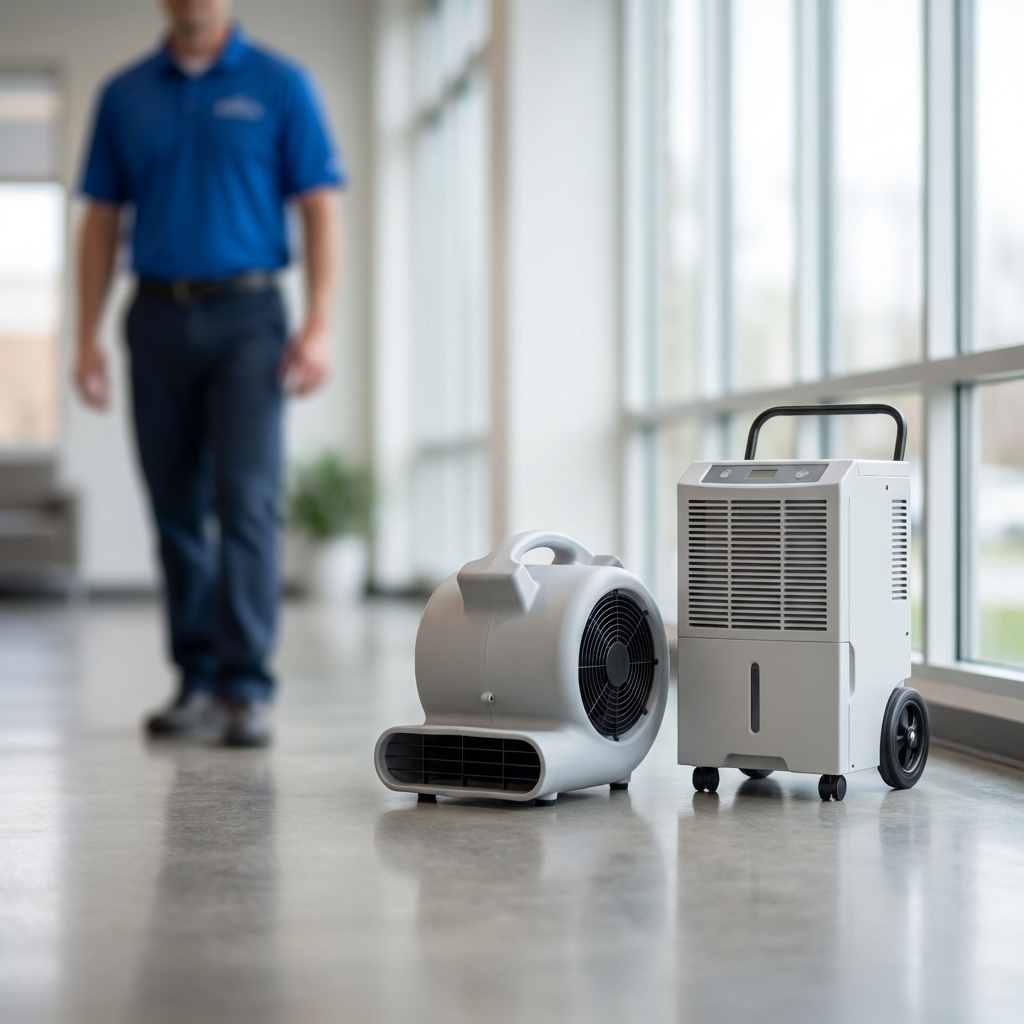
Dehumidification systems: We use refrigerant dehumidifiers and desiccant dehumidifiers based on the specific moisture profile and structural materials involved. Refrigerant units excel at removing moisture when ambient temperature remains above 60 degrees. Desiccant units work effectively in cooler conditions and reach lower relative humidity levels, which is critical when drying sensitive equipment or materials.
Structural drying equipment: Our injectidry systems and wall cavity drying tools force dry air into wall cavities, beneath subflooring, and behind insulation where moisture hides. These targeted systems reach areas that standard equipment cannot access, preventing the hidden moisture pockets that spawn mold months after surface drying appears complete.
Air movement and circulation: We deploy commercial-grade axial fans and air movers in strategic locations to create optimal airflow patterns. This circulation prevents the stagnant pockets where moisture concentrates and ensures that dry air reaches every affected surface continuously.
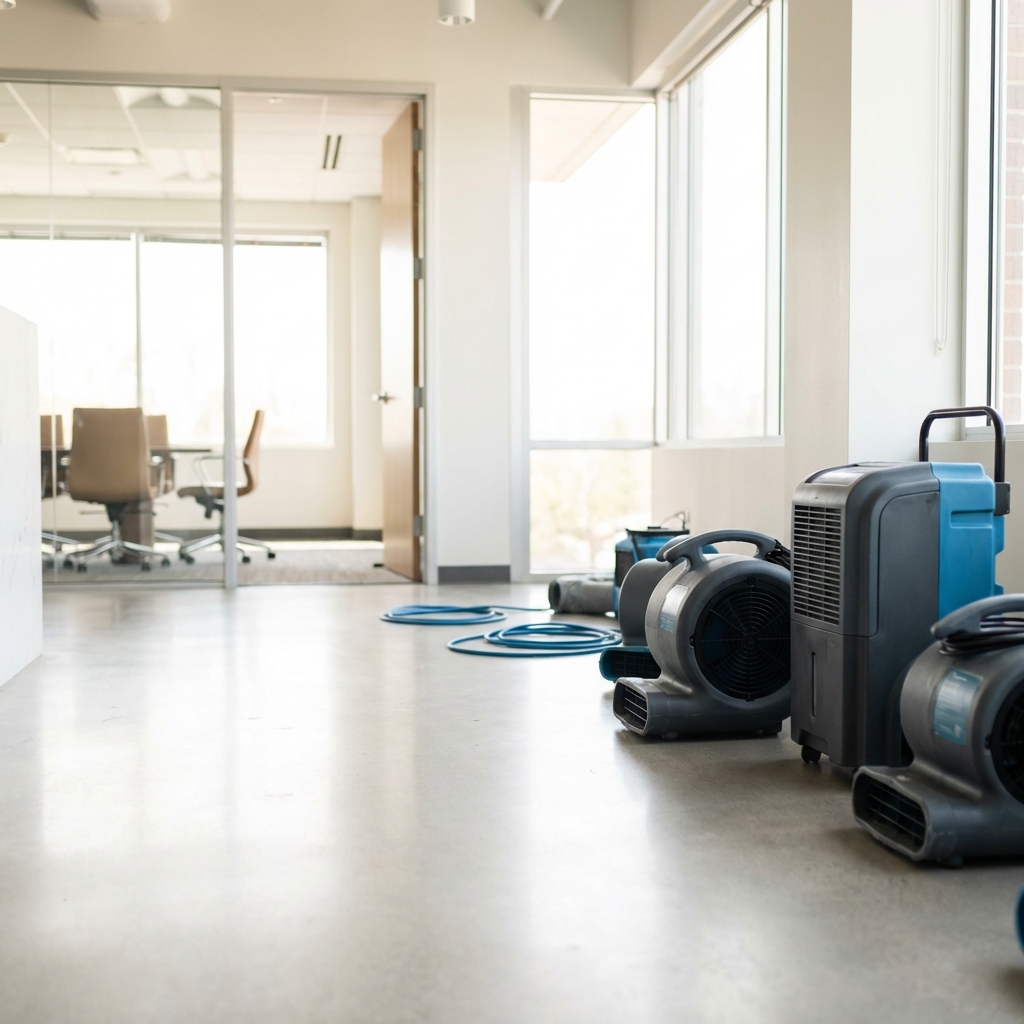
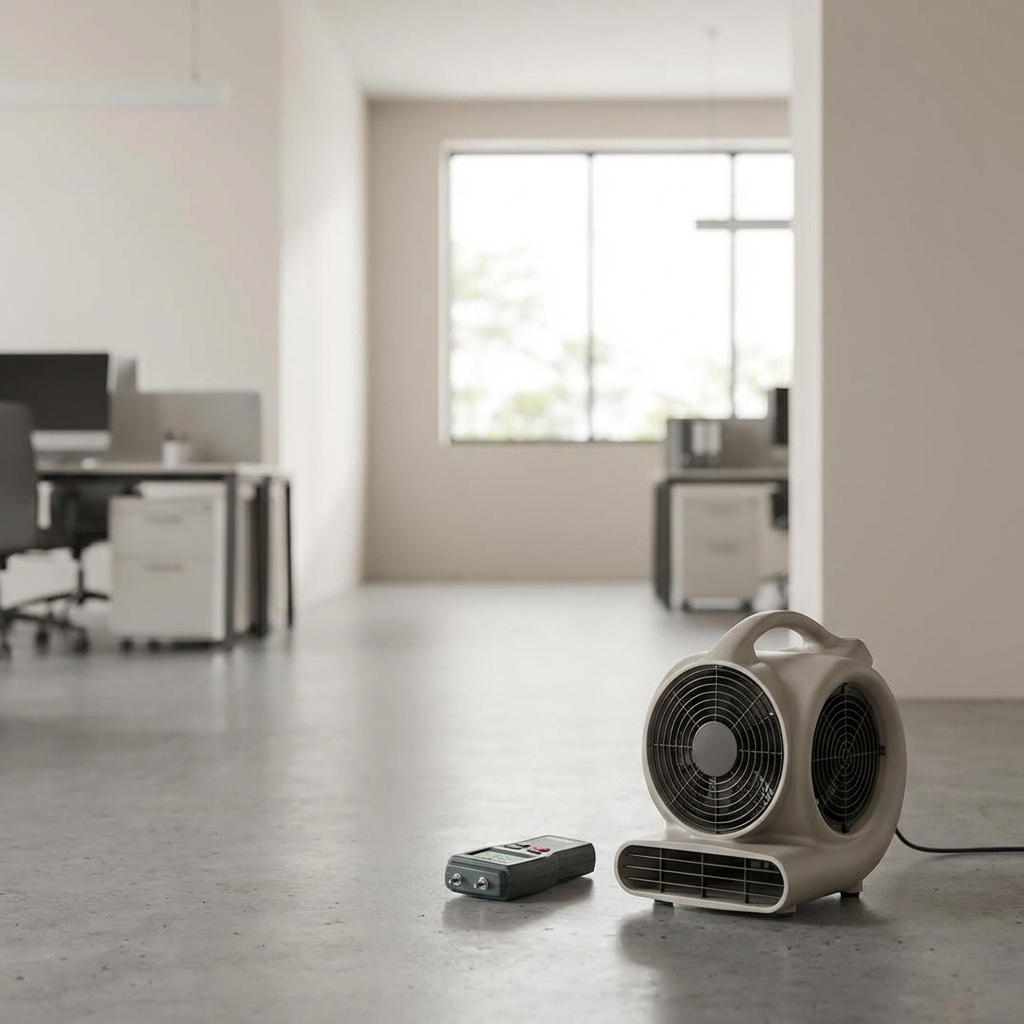
Moisture monitoring technology: Real-time moisture meters and digital hygrometers track moisture levels in structural materials throughout the drying process. We establish baseline readings immediately after water removal, then track progress against industry-standard drying thresholds. This data-driven approach means we don’t guess when drying is complete. We know it’s complete because the numbers prove it.
Our equipment operates continuously, typically running 24 hours per day during the active drying phase. This isn’t optional convenience. Around-the-clock operation accelerates moisture removal by maintaining consistent drying conditions and preventing the rebound effect that occurs when equipment shuts down overnight.
Actionable step: Ask any restoration company about their specific dehumidification capacity and whether they use desiccant or refrigerant systems. The answer tells you whether they’re equipped for serious commercial work.
Our 24/7 Emergency Response for West Palm Beach Businesses
We maintain a dispatch center that operates around the clock, 365 days per year. When you call with water damage at 2 a.m. on a Sunday, you reach a real person who can dispatch our team immediately, not an automated system or call center in another state.
Our response time to commercial properties throughout West Palm Beach and surrounding areas typically runs 60 to 90 minutes from your call. This matters because water continues its destructive work every minute it remains in your structure. Early response prevents spreading and reduces the ultimate scope of restoration required.
We staff multiple crews dedicated to emergency response, so we don’t queue commercial clients behind residential calls or delay service because our single team is occupied elsewhere. Each crew carries complete equipment packages including pumps for immediate water extraction, industrial dehumidifiers, moisture detection tools, and structural drying systems.
Our emergency protocols begin before we even arrive. When you call, we gather specific information about the affected space, water source, and any obvious damage. This intelligence allows us to stage appropriate equipment so we can begin extraction and drying immediately upon arrival rather than spending the first hour assessing what should already be obvious.
For business owners managing the immediate crisis, our team coordinates with you on water shutoff locations, power availability for our equipment, and access routes that minimize disruption to unaffected areas of your building. In some cases, we position equipment outside and run drying systems through strategically opened windows to avoid damage to your building systems.
The first four to six hours of professional response typically determine whether damage remains contained or spreads exponentially. This is why we prioritize West Palm Beach commercial clients for immediate dispatch rather than scheduling service for the next available opening.
Actionable step: Program our emergency number into your phone and your facility manager’s phone now, before disaster strikes. Having quick access means you respond faster when minutes count.
How We Assess and Dry Your Commercial Property
Our assessment process combines systematic visual inspection with quantitative moisture measurement to establish exactly what we’re dealing with and how to address it most effectively.
We begin by identifying the water source and whether it’s ongoing or stopped. An active leak requires repair before aggressive drying begins, otherwise we’re essentially trying to bail out a boat with the pump running. For storm-related intrusion or burst pipes, we confirm the water entry point is secured before proceeding with extraction.
Next, we map the affected area and determine which materials absorbed water and which simply got wet on the surface. Concrete, gyp-board, insulation, wood framing, and flooring all require different drying approaches and have different timelines for reaching acceptable moisture levels. A wet tile floor on concrete substrate might take three to seven days to dry completely, while wet gyp-board behind a finished wall might require targeted injection drying and could take considerably longer.
We measure baseline moisture content in multiple locations within each affected material using calibrated moisture meters. These readings establish our starting point and allow us to track progress objectively rather than relying on visual appearance, which is deeply misleading in commercial environments.
Our drying strategy then accounts for:
- Equipment placement: We position dehumidifiers to maximize coverage while minimizing air-cooling in unaffected areas of your building. Strategic airflow patterns prevent moisture from migrating to currently dry spaces.
- Structural access points: We identify and use existing cavities, access panels, and penetration points to run drying tubes into wall cavities and beneath flooring without destructive removal.
- Restoration timeline: We establish realistic timelines based on material types, moisture levels, and environmental conditions. Commercial clients need to know when they can reoccupy affected spaces.
- Business continuity: We arrange equipment placement and operational schedules to minimize impact on your ongoing operations in unaffected areas.
Daily monitoring includes moisture readings at the same measurement points, equipment inspection and adjustment, and dehumidifier tank or drain line management. As materials approach target moisture levels, we scale back equipment gradually to ensure we don’t reintroduce moisture through condensation when drying becomes too aggressive.
Actionable step: During our assessment, ask specifically about the target moisture levels for each material type and how long we project until your space is truly dry and safe for occupation.
Our Proven Drying Timeline and Efficiency Standards
Industry standards established by IICRC (Institute of Inspection Cleaning and Restoration Certification) guide our drying timelines, but actual duration depends heavily on the specific situation.
For standard commercial water damage in West Palm Beach’s typical climate conditions, typical drying timelines break down roughly as follows:
- Water extraction and initial removal: Same day, typically completed within the first 4 to 8 hours after arrival. High-powered pumps remove standing water quickly. Initial structural drying equipment deployment happens during this phase.
- Active dehumidification phase: Days 2 through 7 for most common scenarios. This is when dehumidifiers and air movers run continuously, aggressively reducing moisture content in affected materials. Daily monitoring occurs to track progress.
- Secondary drying phase: Days 8 through 14. Moisture levels drop more slowly as remaining water deep in structural materials gradually migrates toward dry surface conditions. Equipment operation continues but becomes more targeted.
- Final verification and equipment removal: Day 14 onward. Once moisture readings confirm we’ve achieved target levels (typically 12-17% for most materials), we remove equipment and verify that secondary drying isn’t reintroducing moisture.
Larger commercial spaces, heavy water saturation, or structural complexity might extend these timelines to three to four weeks. Conversely, contained water damage in smaller areas might dry in five to seven days. We’ll never promise a specific timeline until we’ve assessed your actual property.
Several factors accelerate or delay our drying progress:
- Humidity levels: Our tropical West Palm Beach climate makes drying harder than in drier regions. Higher ambient humidity means dehumidifiers must work harder to remove moisture from the air.
- Temperature: Warmer conditions increase evaporation rates. Winter drying (if it occurs) takes longer than summer drying.
- Air circulation: Spaces with good airflow dry faster. Enclosed rooms with poor ventilation require longer drying periods.
- Material types: Concrete and tile dry faster than carpet, wood, or gyp-board. Mixed materials require equipment strategy that balances different drying needs.
Our efficiency standards focus on achieving complete drying without unnecessary equipment rental periods. We remove dehumidifiers the moment moisture levels confirm drying is complete, not because a calendar date arrived.
Actionable step: Ask us for realistic projections specific to your property during the assessment. This allows you to schedule staff return-to-office timing and operations recovery based on actual data rather than guessing.
Protecting Your Business Operations During Restoration
Commercial drying doesn’t mean your entire business shuts down for two weeks. Careful equipment placement and operational planning allows many businesses to maintain partial operations in unaffected areas while we restore the damaged section.
We coordinate equipment staging to avoid unnecessary foot traffic through working office areas and minimize noise disruption during business hours where feasible. For after-hours drying, we deploy additional equipment that runs quietly and efficiently with minimal monitoring needs overnight.
In multi-tenant or complex commercial buildings, we create sealed drying zones around affected areas using temporary barrier systems. This containment prevents moisture and drying equipment noise from affecting adjacent tenant spaces. We also coordinate with building management or facility teams to ensure HVAC systems aren’t circulating moisture throughout the entire building during the drying process.
For businesses with sensitive equipment or inventory, we develop protection strategies before aggressive drying begins. Climate-controlled rooms or sections can be protected during the initial extraction and cleanup phases, then brought into the drying zone later once standing water and heavy moisture are removed.
Our team works flexibly with business schedules. If you need equipment staged outside and drying conducted through exterior access points to keep interior disruption minimal, we accommodate that. If you need early morning or late evening activation of particularly noisy equipment, we schedule accordingly.
Communication is essential. We provide daily updates on progress, any issues encountered, and realistic timelines for achieving drying milestones. Your facility manager always knows what to expect the next day and can inform staff accordingly.
Actionable step: Designate one facility contact person to coordinate with our team daily. This single point of contact eliminates confusion and speeds problem-solving.
Our Insurance Claim Navigation Support
We understand that commercial water damage typically triggers insurance claims, and the claim process adds complexity on top of the urgency of immediate restoration.
Our team works routinely with insurance adjusters and understands what documentation they require to process claims accurately. We photograph and document all damage systematically, capturing before, during, and after conditions. This documentation becomes your evidence for the claim adjuster and supports the scope of work we recommend.
We prepare detailed written assessments that itemize affected areas, affected materials, and restoration scope. Insurance companies need this specificity to approve claims accurately. Vague “flood damage to building” doesn’t give adjusters what they need to make decisions.
Our team coordinates directly with adjusters during site inspections when they arrive to assess the claim. We explain the water damage progression, the reasoning behind our drying strategy, and why specific equipment and timeline are necessary. Adjusters typically appreciate working with certified professionals rather than interpreting damage claims from business owners without technical expertise.
For claims disputes about whether specific areas require restoration or whether damage truly occurred, our moisture readings provide objective evidence. The data doesn’t lie. If moisture levels are above acceptable standards, that’s what the numbers show.
We also help you document business interruption losses if your policy covers that coverage. Detailed records of closure dates, revenue impact, and lost operational time support those claims. The faster we dry your property, the sooner you return to operations and the smaller your business interruption claim.
Actionable step: When calling us immediately after water damage, mention whether you’ve already contacted your insurance company. We’ll coordinate with your adjuster’s timeline and ensure all documentation supports your claim.
Why West Palm Beach Businesses Choose Our Services
Our local presence and specialized commercial expertise set us apart from national chains or generalist restoration companies trying to handle everything from water damage to fire restoration to contents cleaning.
We understand West Palm Beach’s specific challenges. Our tropical climate means humidity-related issues and mold risk are higher than inland areas experience. We’re familiar with the construction styles common to commercial buildings throughout Palm Beach County, which affects how we approach structural drying. We know the local building codes and can discuss compliance requirements intelligently with your building department or commercial contractors.
We maintain our equipment locally and staff our teams with certified technicians who’ve dried hundreds of commercial spaces. This isn’t their first or fifth commercial drying project. They’ve encountered the specific challenges your property presents before and know efficient solutions.
Our 24/7 emergency response isn’t outsourced call center service. Our dispatch team knows local geography and traffic patterns, which is why we achieve 60 to 90-minute response times consistently. We’re not coordinating across time zones or routing calls through distant offices.
We’re invested in the West Palm Beach business community. Our reputation depends on how well we serve local business owners who talk to each other, refer work, and remember which company showed up at 2 a.m. and got their business back online quickly.
Many West Palm Beach commercial clients have called us for water damage, then called us back months or years later for other needs because we delivered professional service and actually solved the problem rather than just moving equipment around.
Actionable step: Ask any restoration company how many commercial drying projects they’ve completed in West Palm Beach County specifically. The answer reveals whether you’re working with specialists or generalists.
Next Steps: Getting Your Property Restored Today
If your commercial property is currently experiencing water damage, the first action is immediate water extraction and emergency response. Call us now at 24/7 emergency dispatch and we’ll have a team heading to your location within the hour.
If you’re in the planning stage and want to understand our approach before a crisis arrives, we offer no-obligation consultations. We can tour your facility, discuss potential water vulnerability points, and explain how we’d approach drying specific areas if water damage occurred. This pre-planning sometimes reveals simple improvements that reduce water damage risk going forward.
For business owners currently in the middle of water damage restoration with another company, you can request a second opinion. We’ll assess their approach and tell you honestly whether their timeline and equipment strategy make sense for your situation.
Our commercial water damage restoration services are backed by industry certifications, insurance company partnerships, and a track record of getting West Palm Beach businesses restored and operational quickly. We carry the equipment, staffing, and expertise to handle emergency drying for spaces from a few thousand square feet to large industrial or commercial complexes.
Contact SuperClean Restoration now. Reach us by phone for immediate emergency response, or use text for faster communication if you’re in the midst of managing the crisis. We’ll dispatch our team immediately and begin the systematic process of extracting water and drying your structure before secondary damage becomes irreversible.
Your business’s recovery depends on swift, professional action during the first critical hours. We’re ready to provide it.