When Water Damage Strikes Your Palm Beach Home or Business
A burst pipe at 2 a.m. on a Sunday. A sudden downpour that overwhelms your crawl space. A storm surge pushing through ground-level windows. These scenarios unfold constantly across Palm Beach County, and when they do, property owners face a critical choice: who do you call?
We understand the panic that hits when water damage threatens your home or business. The first 24 to 48 hours are absolutely decisive. During this window, moisture begins saturating building materials, promoting mold growth, and causing structural compromise that becomes exponentially more expensive to repair the longer it sits untreated. Your initial response determines whether you’re looking at a contained, manageable restoration or a months-long remediation nightmare with potential health hazards.
Most property owners default to whoever answers the phone fastest or whoever their insurance company recommends. But speed alone doesn’t equal quality restoration. We’ve cleaned up after jobs where national chains prioritized volume over precision, leaving moisture trapped in wall cavities and building conditions ripe for future mold colonization. These shortcuts protect their bottom line, not your property.
The difference between a competent restoration company and an exceptional one becomes visible only after weeks and months pass. That’s when you discover whether the drying was truly complete, whether hidden moisture was actually detected and addressed, or whether you’re facing a second disaster masked by the first.
The Critical Difference Between Local and National Restoration Companies
National restoration chains operate with a fundamentally different business model than we do. Their structure revolves around standardized processes, centralized management, and franchise operations spread across multiple states. They measure success by jobs completed, not by long-term outcomes for individual properties. When a technician finishes your job, the relationship ends. There’s no accountability if problems emerge three months later.
We operate differently because we’re deeply embedded in this community. Our reputation doesn’t stretch across thirty states; it’s built on the trust of Palm Beach County homeowners and business owners who’ve worked with us, referred us to neighbors, and relied on us repeatedly. We live here. Our families live here. When someone experiences poor restoration work from us, we hear about it directly through our local network. That direct accountability creates pressure to do the work right the first time.
National chains also face inherent logistical challenges. When you call their 1-800 number, you’re routed to a distant call center that knows nothing about Palm Beach County flooding patterns, local building codes, regional humidity levels, or which contractors and inspectors we work with regularly. Your call gets logged, assigned to whoever’s available that day, and handled as one of dozens of similar calls their operator is managing. By contrast, we answer our own phones or connect you with team members who’ve already worked hundreds of local restoration jobs and understand the specific challenges our climate presents.
Our local advantage extends to parts acquisition, contractor coordination, and inspector relationships. When we need to order specialty equipment or materials, we work with local suppliers who understand our standards. When we need to coordinate with local building inspectors, we have established relationships that move the process forward smoothly. When we need peer review or second opinions on structural decisions, we tap into our local professional network.
What to do next: When calling for emergency restoration services, ask whether the company is locally owned and whether the person handling your case will be the same person overseeing your entire project.
Why Response Time Matters in Water Damage Emergencies
The first hour after water damage occurs, your property is in a critical state. Moisture is spreading into materials that haven’t yet absorbed water. Humidity is still rising but hasn’t saturated the entire space. This window is when aggressive extraction and air movement prevent the worst outcomes.
We operate 24/7 because water damage doesn’t schedule itself around business hours. A pipe burst at 3 a.m. on Christmas doesn’t wait until Monday morning. When you call us during an emergency, you’re reaching our actual dispatch team, not a voicemail system or an answering service that will try to route you somewhere else. Our crews are positioned throughout Palm Beach County, which means our average response time to residential or commercial emergencies is under 60 minutes from initial contact.
This matters concretely. Within that first hour, we can extract standing water, begin air movement with dehumidification equipment, and assess the full scope of damage. These actions prevent moisture from penetrating deeper into walls, insulation, and subflooring. They also prevent the stagnant water conditions that encourage bacterial growth and mold spore activation.
We’ve responded to countless situations where property owners waited for business hours to call because they assumed no one worked emergencies at night. By the time they connected with a contractor the next morning, moisture had already begun migrating into spaces where it becomes invisible but devastating. Once water moves into wall cavities or underneath hardwood flooring, the damage multiplies in complexity and cost.
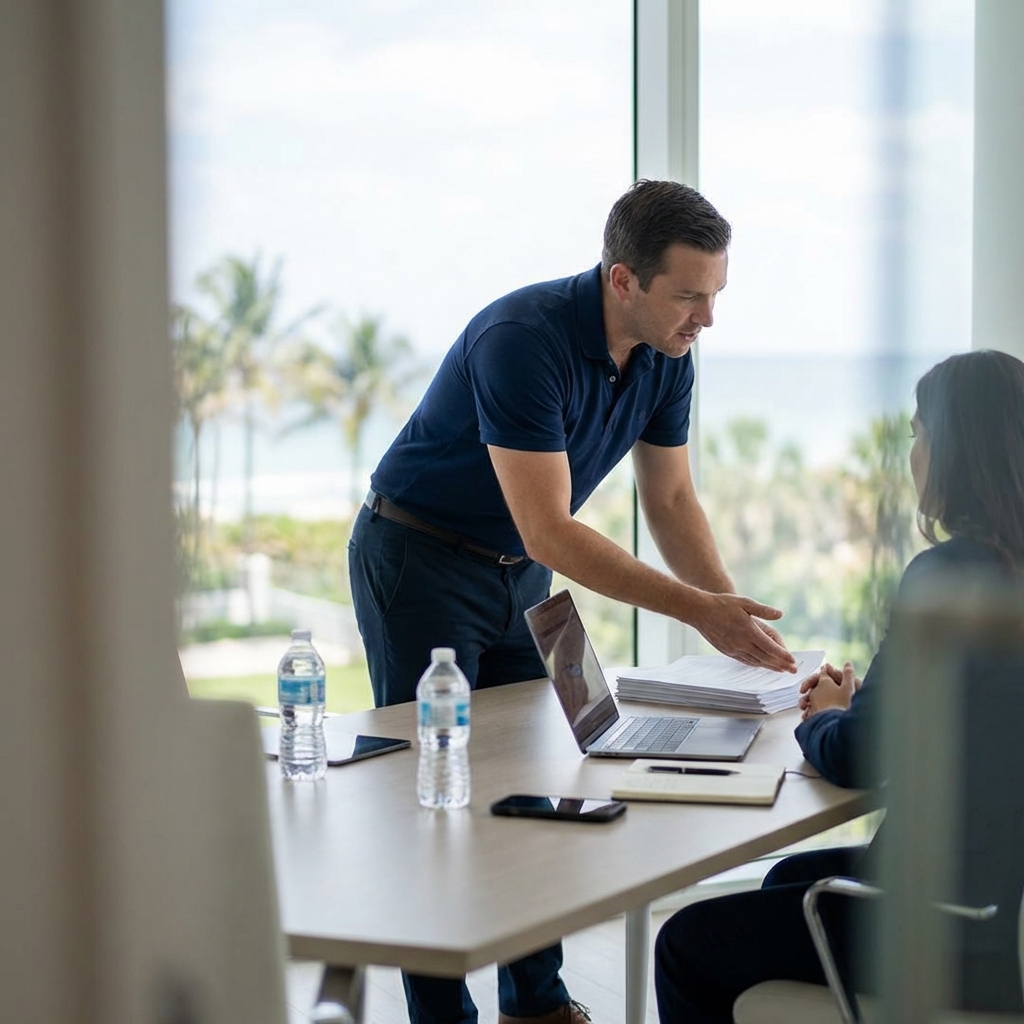
Response time also directly impacts insurance claims. Most policies contain language requiring the policyholder to mitigate further damage. When you respond quickly, documenting the water’s extent before it spreads, you strengthen your claim and demonstrate due diligence. Adjusters recognize rapid professional response as evidence of reasonable mitigation efforts. Delayed response sometimes triggers coverage disputes because insurers argue you should have acted faster.
Actionable next step: Save our number in your phone today. When an emergency occurs, you’ll know exactly who to call instead of wasting time searching for available contractors.
Our Structural Drying and Disinfection Process Explained
Once we’ve extracted standing water, the real work begins. Drying a water-damaged building is fundamentally different from simply running fans and hoping moisture evaporates. We follow a structured process designed to track moisture levels, prevent secondary damage, and ensure complete dryness in all affected materials.
We deploy moisture monitoring equipment throughout affected areas, measuring moisture content in materials like drywall, framing, subflooring, and insulation. These readings provide objective data about where moisture actually exists rather than relying on visual inspection or assumptions. We take readings at the beginning of the drying process, then at regular intervals (typically every 24 to 48 hours) to confirm that moisture is consistently decreasing.
Our drying approach uses strategic placement of air movers, dehumidifiers, and targeted ventilation. Different materials and different conditions require different approaches. A flooded basement with concrete floors needs different equipment placement than a water-damaged living room with carpet and drywall. We assess air flow patterns, temperature, existing humidity levels, and material types to create an efficient drying strategy rather than simply placing equipment randomly throughout a space.
Disinfection happens as drying progresses. Water damage introduces contamination from floodwater, sewage, or simply stagnant water that encourages bacterial growth. We apply hospital-grade disinfectants to affected surfaces and materials, targeting pathogens that pose health risks. In cases of category 2 or category 3 water (contaminated floodwater or sewage backup), we’re especially rigorous because the health implications are more severe.
We document the entire process with written records, moisture readings, photographs, and equipment logs. This documentation protects you during insurance claims and provides evidence that we followed industry-standard practices. When an adjuster questions whether drying was adequate, we can present objective moisture data instead of relying on verbal assurances.
Action item: After water damage occurs, request that your restoration company provide you with a written drying plan and regular moisture readings documented in writing. This protects your interests and ensures accountability.
Mold Testing and Remediation: Our Comprehensive Approach
Mold growth is the hidden consequence that many property owners discover weeks after water damage. Initial drying might appear successful, but if moisture remained trapped in walls or subflooring, mold begins colonizing those spaces invisibly. The first sign is often an odor, a visible discoloration, or respiratory symptoms in occupants.
We approach mold with both prevention and remediation. During the water damage restoration process, our drying protocols are designed to prevent the conditions mold needs: moisture, organic material, and time. By ensuring complete drying and disinfecting surfaces that are prone to mold growth, we eliminate the foundation for mold problems.
When mold is discovered (either during restoration or separately), we conduct testing that identifies the mold species present and the extent of contamination. Not all mold is equally dangerous, and testing tells us what we’re dealing with. Some mold varieties cause respiratory symptoms in sensitive individuals; others are relatively harmless. Our testing provides clarity about whether you’re facing a health concern that requires specialized remediation.
Remediation depends on the extent and location of mold growth. Surface mold on bathroom tiles requires simple cleaning and moisture control. Mold embedded in drywall or insulation requires removal and replacement of affected materials. Extensive mold in crawl spaces or attics might require encapsulation or professional air filtration. We assess each situation individually and recommend the approach that actually solves the problem rather than simply treating the visible symptoms.
We also identify and address the moisture conditions that allowed mold to grow. Mold recurrence is common when the underlying moisture problem isn’t solved. If mold is growing because your crawl space stays damp year-round, we address drainage, vapor barriers, or ventilation. If mold is growing because a roof leak persists, we coordinate with roof contractors to fix the leak. This approach prevents the frustrating cycle of repeated mold problems.
Key step: After water damage, request baseline mold testing (a surface sample) to establish what conditions exist before hidden mold growth begins. This documentation helps if mold problems emerge later.
Insurance Claims Navigation: How We Guide You Through the Process

Insurance claims for water damage are rarely simple. Coverage depends on the water’s source, your specific policy language, whether you maintained your property adequately, and how well you document the damage. Many property owners navigate this process alone and inadvertently reduce their claim payout by missing documentation requirements or misunderstanding coverage limits.
We work with your insurance adjuster throughout the restoration process. When the adjuster visits your property, we’re present to walk them through what happened, what we found, and what we’re doing to remediate. We explain the moisture readings, show the disinfection process, and demonstrate that we’re following industry standards. This direct communication with the adjuster prevents misunderstandings and supports your claim.
We document everything in writing because insurance claims live and die on documentation. We provide you with detailed invoices that itemize labor, materials, and equipment. We give you before-and-after photographs. We provide moisture readings, disinfection records, and equipment logs. We explain our process in plain language so you can present it to your adjuster if needed. This comprehensive documentation strengthens your claim and provides backup if the insurance company later questions whether restoration work was necessary or properly performed.
We also help you understand what your policy covers. Some policies cover water damage from internal sources (burst pipes) but not external sources (flooding). Some have specific limitations on categories of loss. We’ve worked through hundreds of claims and can usually tell you upfront what you should expect coverage-wise, though we always recommend discussing specifics with your agent or adjuster.
For commercial properties, claims become more complex because business interruption and additional living expenses might apply alongside direct damage coverage. We’ve coordinated with commercial property managers and business owners to ensure that restoration work is documented in ways that support these claims.
Practical step: Before you need us, contact your insurance agent and ask specifically what types of water damage your policy covers, what documentation they’ll require for a claim, and what your deductible is. This clarity helps you make faster decisions during an actual emergency.
Hurricane Damage Recovery: Specialized Knowledge for Palm Beach Storms
Hurricane season in Palm Beach County isn’t theoretical. We live with the reality of seasonal storms that can damage dozens of properties in a single afternoon. This experience has taught us patterns and priorities that national contractors operating in non-hurricane regions simply don’t understand.
We know that hurricane damage isn’t just water damage. Storms bring wind damage, debris impact, flooding from storm surge and rainfall, and sometimes structural compromise that creates secondary water intrusion. We evaluate properties with this complexity in mind. A roof missing shingles isn’t just an aesthetic problem; it’s an open door for water penetration during the days and weeks while repairs are pending.
Our hurricane response includes immediate emergency mitigation: tarping roofs to prevent further water entry, removing debris, securing windows and openings, and extracting standing water. This rapid mitigation prevents the restoration work from becoming exponentially more expensive as days pass and additional moisture enters the building. We often begin mitigation work before the full scope of damage is assessed because limiting further damage is the priority.
We’re also experienced with the logistical challenges of post-hurricane recovery. Contractor availability becomes extremely limited immediately after a major hurricane. We’ve already established relationships with trusted subcontractors (roofers, electricians, structural engineers) who we coordinate with on hurricane recovery jobs. When you work with us for hurricane recovery, you benefit from these pre-established relationships instead of trying to find qualified contractors yourself in the chaotic period after a major storm.
Our team includes structural assessment specialists who can evaluate whether water damage has compromised framing, bearing walls, or foundation integrity. In hurricane situations, this assessment is critical because wind damage sometimes creates structural vulnerabilities that water damage assessment alone wouldn’t identify. We coordinate with structural engineers when necessary and communicate findings clearly so you understand what your property needs.
Next action: If you own property in Palm Beach County, develop a hurricane preparedness plan that includes knowing which restoration company you’ll call and what that company can handle on an emergency basis. Having this decision made before a hurricane arrives means faster response when disaster strikes.
Why Our 24/7 Local Team Beats National Call Centers
There’s a fundamental difference between a company that answers its phones 24/7 with a team that knows your area and a company that operates a national call center handling thousands of calls daily across multiple states.
When you reach us during an emergency, you’re speaking with someone who understands Palm Beach County. They know which neighborhoods experience frequent flooding due to drainage patterns. They understand local building codes and contractor standards. They can dispatch crews quickly because they know where people are positioned. They make decisions based on local knowledge instead of generic protocols designed to work everywhere and optimize nowhere.
National call centers are optimized for volume and consistency. The operators follow scripts and decision trees designed to handle callers from Maine to Hawaii with the same approach. They don’t know whether you’re dealing with saltwater intrusion (which requires different protocols than freshwater) or whether your property is in an area with chronic moisture issues. They route your call to whoever’s available rather than to someone familiar with your region’s specific challenges.

We also remain involved in your project. The person who takes your initial emergency call will likely be someone who coordinates with the team handling your restoration. There’s continuity instead of handoffs. You’re not explaining your situation repeatedly to different people; instead, information flows smoothly as the project progresses.
Our team works within a local structure where reputation directly impacts our business. If we cut corners or deliver mediocre work, people in Palm Beach County eventually hear about it. We can’t hide behind corporate anonymity; we’re accountable to this community. That accountability drives higher standards than national operations face because local word-of-mouth reputation is our primary marketing tool.
Concrete takeaway: Ask any restoration company you consider whether the person handling your emergency call will also oversee your entire project. If they can’t guarantee continuity, you’re dealing with a call center operation.
Serving Wellington, Royal Palm Beach, and Your Community
We serve the full spectrum of Palm Beach County communities, from Wellington and Royal Palm Beach to Jupiter, Palm Beach Gardens, and the coastal areas. Each community has its own characteristics and challenges. We understand them because we work in them constantly.
Wellington properties often deal with specific flooding patterns related to the area’s topography and drainage infrastructure. Royal Palm Beach properties face different challenges based on their proximity to water bodies and local rainfall patterns. Jupiter and northern county properties have their own vulnerabilities. We’ve learned these patterns through hundreds of restoration jobs and adjust our approach based on what we’ve learned from each area.
This local service means we’re familiar with the contractors, inspectors, and vendors in each community. When we need to coordinate with local code enforcement or connect with specialists, we’re working with people we already know and trust. This efficiency benefits you through smoother project coordination and faster problem-solving.
We also understand the community-level impacts of water damage and storms. After a major hurricane, we’re not just helping individual properties; we’re contributing to neighborhood recovery. We prioritize rapid response during these periods because we understand the broader community effects of delayed restoration. When neighbors help neighbors recover quickly, entire communities stabilize and move forward faster.
What this means for you: When selecting a restoration company, choose someone with deep roots and long-term presence in your specific area. Local expertise translates to better decisions and faster, more appropriate solutions.
What Sets SuperClean Apart in Quality and Accountability
We’re water and mold experts with a commitment to restoration that prioritizes your property’s long-term health over quick profit. This commitment shows up in specific, tangible ways throughout every project we handle.
We document everything. Written reports, moisture readings, photographs, and equipment logs create an objective record of what we found, what we did, and what outcomes we achieved. This documentation protects your insurance claim and gives you evidence of professional work if you ever need to reference the restoration process.
We don’t recommend unnecessary work. Some contractors automatically replace drywall, flooring, or insulation if they’ve been wet. We take a more measured approach. If materials can be dried successfully and function normally afterward, we dry them. If they truly need replacement, we recommend it. This approach saves you money while still protecting your property.
We communicate clearly about timelines and costs. Restoration projects have variables, and sometimes the scope grows as we discover hidden damage during the process. When this happens, we explain what we found, why additional work is necessary, and what it will cost before proceeding. We don’t surprise you with unexpected bills or rush you into decisions.
We stand behind our work. If moisture readings suggest incomplete drying, we continue the process until drying is truly complete. If mold appears in an area we remediated, we address it because the initial remediation wasn’t sufficient. We don’t consider a job finished until the property is genuinely restored.
Final action item: Choose a restoration company today before you need one. Verify they’re locally owned, available 24/7, and willing to provide written documentation of all work. Having this decision made in advance means faster response and better outcomes when disaster strikes.
Water damage doesn’t wait, and neither do we. When your Palm Beach County property faces water damage, mold concerns, or hurricane aftermath, our team is ready to respond immediately with the expertise and local knowledge that actually makes a difference in restoration outcomes.