Why Commercial Water Damage Claims Require Specialized Expertise
When a pipe bursts in your office building or a storm floods your retail space, the first 24 hours determine whether you recover quickly or face months of disruption. Commercial water damage isn’t just about cleanup—it’s about minimizing downtime, protecting your bottom line, and navigating insurance claims correctly the first time.
We’ve handled hundreds of commercial water damage claims across Palm Beach County, and we’ve learned that the difference between a smooth recovery and a financial nightmare often comes down to who you call first. This guide walks through what we do differently when handling commercial water damage claims and why the expertise you choose matters more than most business owners realize.
Commercial properties present fundamentally different challenges than residential homes. Your building likely contains inventory, expensive equipment, multiple tenants, and complex insurance policies that require careful handling. When water damage strikes, you’re not just dealing with structural issues—you’re managing business interruption, liability concerns, and regulatory compliance.
We work with commercial clients who’ve learned the hard way that general restoration companies often underestimate scope or miss secondary damage that surfaces weeks later. Commercial claims require someone who understands:
- Building codes and compliance requirements specific to commercial spaces
- Multi-policy scenarios where coverage may span multiple insurance carriers
- Business interruption provisions that can be worth more than the direct damage itself
- Documentation standards that insurance adjusters and loss assessments actually review
- Timeline pressures that affect both your operations and claim validity
Our team includes restoration specialists who’ve spent years working exclusively with commercial properties. We know the difference between what looks fixed and what actually is fixed. We’ve also built relationships with commercial insurance adjusters across Palm Beach County, which means we can communicate efficiently about your claim from day one.
The cost of getting this wrong is steep. We’ve seen businesses lose thousands in valid claim coverage because initial documentation was incomplete, or secondary damage went undetected and became the owner’s responsibility later.
The Critical First Hours: Our Immediate Response Advantage
When you call us, we answer within minutes, not hours. Our 24/7 emergency team is already moving toward your property while we’re gathering details about what happened and what we’re walking into.
Those first hours are when we:
- Stop ongoing water intrusion and prevent water from reaching areas it hasn’t damaged yet
- Photograph and document initial conditions before anything shifts or dries
- Identify hidden moisture that standard visual inspection would miss using moisture detection equipment
- Assess whether the situation requires emergency equipment placement that affects your building access
- Begin the paper trail that insurance companies actually need to process your claim
We deploy industrial-grade equipment immediately—not to bill you for unnecessary services, but because commercial spaces often have water in places you can’t see. Behind walls, under flooring, in HVAC systems, and within structural cavities. If we don’t address these pockets in the first 24 hours, mold growth becomes inevitable within 48 to 72 hours.
Our rapid response also protects your insurance claim. Documentation created within the first few hours carries more weight with adjusters than photos taken three days later after partial drying has begun. We photograph wet conditions, equipment placement, and initial assessment findings in a standardized format that adjusters recognize and trust.
Next step: When water enters your building, contact us immediately rather than waiting to assess damage yourself. The difference in claim outcomes between rapid professional documentation and DIY assessments often runs into tens of thousands of dollars.
How We Navigate Insurance Claims for Maximum Recovery

This is where commercial restoration differs most from general property cleanup. Insurance claims for commercial water damage involve multiple layers: the property itself, business interruption coverage, contents coverage, and sometimes third-party liability if the damage resulted from someone else’s negligence.
We function as a bridge between your building, your insurance company, and your recovery timeline. Here’s what that looks like in practice:
We prepare detailed scope-of-work documents that itemize every affected area, the damage category, and the restoration method required. We use industry-standard damage assessment tools and formats (like IICRC documentation standards) that insurance adjusters understand and can verify. A generic list of damaged items won’t get you full claim approval. A detailed assessment showing square footage of affected drywall, inventory destruction with photographic evidence, equipment displacement costs, and timeline impacts will.
We also identify what’s typically missed. Many commercial claims leave money on the table because building owners and general contractors don’t account for:
- Labor costs for business continuity during restoration (running operations from temporary locations)
- Equipment rental for dehumidifiers, air movers, and monitoring devices
- Third-party testing and certification of mold remediation completion
- Disposal costs for damaged materials that must be handled as hazardous waste
- Contents restoration (not just removal) when inventory or office materials are salvageable
Our documentation process gives your insurance adjuster everything needed to approve these often-overlooked line items. We’ve also trained our team to communicate directly with adjusters about scope changes or additional discoveries. When we find something unexpected during restoration, we don’t just proceed and bill later—we document the finding, photograph it, and get explicit approval before moving forward. This protects both your claim and our credibility.
We also help you understand your coverage limits and what you might need to cover out of pocket. If your policy has a $50,000 cap on business interruption but you’re facing $200,000 in lost revenue, we tell you that upfront. We can’t change your coverage, but you deserve to know what you’re facing and can explore additional recovery options.
Our Comprehensive Damage Assessment and Documentation Process
Assessment is where the real expertise shows. A thorough commercial damage assessment takes time, systematic methodology, and equipment that most general contractors don’t carry.
We begin with a walkthrough that identifies all affected areas—not just visible water, but moisture signatures on materials that appear dry. We use thermal imaging cameras and moisture meters to map moisture distribution within walls, ceilings, and floors. For a 10,000-square-foot commercial space, this might take 4 to 6 hours, but it catches damage that visual inspection alone would miss.
Once we understand the full scope, we create a detailed damage map that shows:
- Room-by-room breakdown of affected materials (drywall, flooring, insulation, etc.)
- Moisture content readings at specific points
- Category assessment (Category 1 is clean water, Category 2 involves contaminated water, Category 3 requires hazmat protocols)
- Affected HVAC systems and whether they require replacement or can be restored
- Contents damage with individual item documentation where replacement cost justifies it
- Structural concerns that might affect safety or building code compliance
We photograph everything with metadata that includes timestamps and location information. Digital documentation allows your adjuster to review findings without requiring multiple site visits, which speeds claim approval.
For commercial properties, we also assess what needs to happen before restoration can begin. Sometimes utilities need to be shut off. Sometimes structural shoring is necessary. Sometimes the building needs to be temporarily unoccupied while we work. We identify these requirements upfront rather than discovering them mid-project, which keeps timelines predictable and prevents claim delays.
Next step: Request a comprehensive moisture assessment before accepting any restoration quote. Ask specifically what equipment will be used to detect hidden moisture and whether documentation will be formatted for insurance adjuster review.
Advanced Restoration Technology and Methods We Deploy
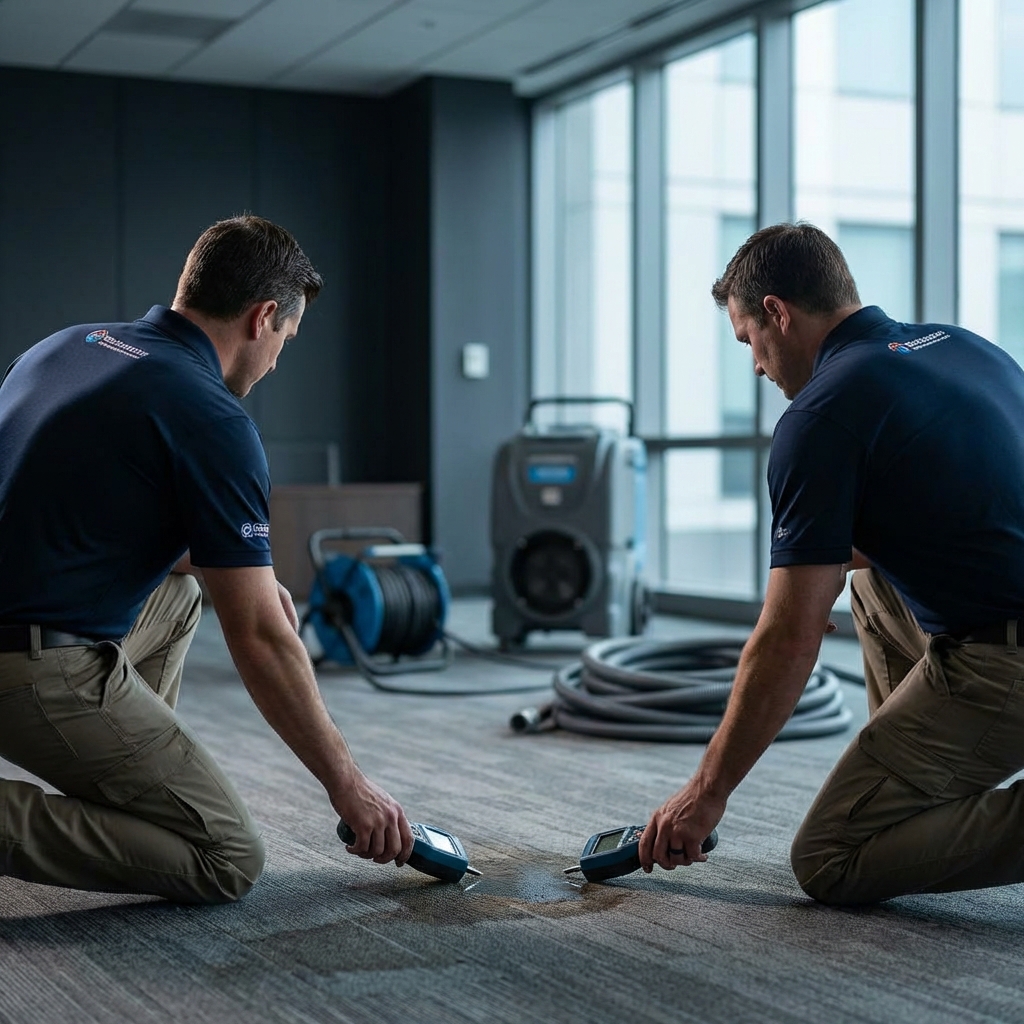
Commercial restoration demands equipment and techniques that exceed standard water removal. We maintain an inventory of industrial-capacity equipment specifically because commercial spaces often require capabilities that residential jobs don’t.
Our standard commercial deployment includes:
- Commercial-grade dehumidifiers (we carry units that remove 200+ gallons of moisture per day, compared to 50-gallon residential models)
- High-velocity air movers positioned to create air flow patterns that accelerate evaporation from difficult-to-reach areas
- Moisture monitoring equipment that tracks drying progress across multiple days, allowing us to adjust our approach based on real data
- HEPA-filtered air scrubbers that prevent dust and mold spores from traveling to unaffected areas
- Moisture barriers and vapor sealing equipment when materials need drying in place rather than removal
The method we choose depends on what failed. If a hot water heater flooded a small office, we might extract standing water, remove a few feet of affected drywall, and run equipment for 48 hours. If a roof leak flooded structural cavities in a commercial building, we might need to drill strategic access points, run monitored drying for 7 to 10 days, and verify moisture levels daily to ensure we’re actually drying rather than just running equipment.
We also use moisture content testing throughout the process. Rather than guessing when materials are dry, we measure actual moisture content and only close walls or resume normal operations when readings confirm everything is actually dry. This prevents future mold growth and claim denials based on incomplete restoration.
For contaminated water situations (Category 2 or 3), our process becomes more rigorous. We may need to remove and dispose of affected materials rather than dry in place. We follow IICRC standards for contamination handling, which means protective equipment, controlled disposal, and post-remediation testing to verify contamination removal.
Mold Remediation and Secondary Damage Prevention
Water damage and mold growth are inseparable unless you address moisture aggressively in those first 48 to 72 hours. We prevent mold, but we also remediate it if it’s already present when we arrive.
Prevention starts during the initial response. The faster we dry materials, the lower the mold risk. But prevention also requires proper air circulation and humidity control. In commercial spaces with high humidity or poor ventilation, we sometimes need to run equipment longer than the obvious visible moisture suggests. This is where experienced judgment matters. A contractor running standard timelines might stop equipment after three days. We might continue for five or six days because we’ve identified moisture conditions that don’t visibly improve and need continued equipment operation.
When mold is already present, remediation depends on extent and location. Small areas (less than 10 square feet) can often be cleaned and treated on site with antimicrobial agents. Larger areas typically require removal of affected materials followed by disposal as regulated waste. Very extensive mold (typically resulting from prolonged moisture exposure) might require temporary isolation of affected areas and phased removal to maintain building access for your operations.
We test for mold presence using spore count testing and identify the mold species when remediation is necessary. Different mold types require different treatment approaches, and insurance adjusters increasingly expect testing results to support remediation scope. We provide post-remediation clearance testing that confirms mold removal before your building returns to normal use.
Preventing secondary damage also means managing humidity levels during and after restoration. Commercial buildings often have HVAC systems designed for normal conditions, not for the aggressive humidity control needed during water damage recovery. We sometimes need to supplement HVAC capacity or isolate affected zones to prevent moisture from spreading through ductwork to unaffected areas.
Next step: If you see any visible mold or detect musty odors within 72 hours of water intrusion, arrange testing immediately. Early identification determines whether remediation is a line item or a budget-breaking afterthought.
Timeline and Cost Efficiency in Commercial Restoration
Commercial water damage restoration timelines matter because every day your building is partially out of operation costs money. The question isn’t how cheaply we can restore your building—it’s how efficiently we can restore it while protecting your insurance claim and keeping your operation moving.
A typical commercial restoration timeline looks like this:
- Hours 0-4: Emergency response, water extraction, equipment deployment
- Hours 4-24: Initial assessment, documentation, equipment optimization
- Days 1-7: Active drying with daily monitoring and adjustment
- Days 7-14: Final assessment, equipment removal, wall closure, final documentation
- Days 14-21: Follow-up verification testing if mold remediation was required
This timeline assumes straightforward Category 1 water damage without extensive mold remediation. Category 2 or 3 situations, or situations where mold already exists, typically extend to 3 to 4 weeks.
Cost efficiency comes from doing it right the first time. If we dry incompletely and mold grows, you’re now facing a second restoration project at higher cost. If we don’t document comprehensively, your insurance company denies portions of your claim. If we use undersized equipment and drying takes twice as long, your business interruption costs dwarf any savings from cheaper equipment rental.
Our approach prioritizes:
- Rapid water extraction to prevent material saturation (saturated materials take weeks to dry; damp materials take days)
- Proper equipment sizing and positioning rather than “good enough” approaches
- Daily documentation and adjustment rather than set-and-forget procedures
- Direct communication with your business about timeline impacts and what’s required
We also provide transparent cost breakdowns before work begins. You know what we’re charging for labor, equipment, testing, and disposal. You understand why commercial restoration costs more than residential work. And you have the information needed to discuss costs with your insurance adjuster.
Next step: Request a detailed timeline estimate before accepting any commercial restoration quote. Understand what’s included in equipment costs and what happens if drying takes longer than projected.
Why Palm Beach County Businesses Trust SuperClean Restoration
We’ve spent years building relationships with Palm Beach County commercial property owners, facility managers, and business continuity professionals. That reputation rests on consistent execution, transparent communication, and commitment to protecting both your building and your bottom line.
When we work on your commercial water damage claim, you get:
- Immediate 24/7 response with a team that reaches your property within minutes
- Comprehensive assessment and documentation formatted for insurance claim processing
- Direct communication with your insurance adjuster throughout restoration
- Advanced equipment and techniques that actually dry buildings rather than just running processes
- Mold testing and remediation conducted to industry standards with post-remediation verification
- Transparent pricing and timeline management with no surprises
Our team includes specialists trained in commercial restoration protocols, insurance claim navigation, and building systems. We’re not general contractors trying to handle water damage as one service among many. We specialize in emergency restoration because commercial properties demand specialists.
The most important difference, though, is that we treat your claim recovery as seriously as you do. When your building floods, your business faces real consequences. We’ve structured our process around minimizing those consequences while maximizing what your insurance covers.
We’re ready to respond to your commercial water damage emergency right now. Contact us when you need emergency restoration specialists who understand both the technical demands of commercial drying and the business impact of downtime.
Our Palm Beach restoration experts maintain equipment, staffing, and response protocols designed specifically for situations where minutes matter and documentation determines financial outcomes. Whether you’re facing pipe damage, storm flooding, or unexpected system failure, we provide the rapid, professional response that keeps your claim on track and your recovery moving forward.
For further reading: Palm Beach restoration experts.