When Every Minute Counts: The Real Cost of Slow Water Damage Response
When water damage strikes your Palm Beach home or business, the clock becomes your biggest enemy. We understand that those first few hours determine whether you’re looking at a contained cleanup or a catastrophic loss. That’s why we’ve built our entire operation around one core principle: get there fast, assess accurately, and start restoration immediately.
Water doesn’t wait, and neither should your restoration team. Within the first 24 to 48 hours of water intrusion, mold spores begin colonizing affected materials. Drywall absorbs moisture and loses structural integrity. Wooden subflooring warps beyond repair. Insulation becomes a breeding ground for microbial growth that can spread through your HVAC system.
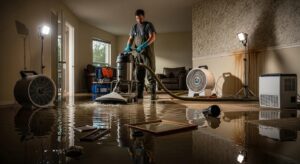
We’ve documented the financial impact across hundreds of Palm Beach properties. A homeowner who calls us within the first four hours typically faces restoration costs between 40% and 60% lower than those who wait 24 hours or more. That difference isn’t theoretical. Consider a 2,000-square-foot home with three inches of standing water in the living room and hallway. Immediate response means we extract water before it seeps into the subfloor. Delayed response means we’re replacing subfloors, treating structural beams, and remediating mold that’s already established.
The emotional toll matters too. Every hour without professional intervention is an hour you’re watching your home deteriorate and wondering if your insurance will cover the damage. Our rapid response eliminates that uncertainty and gives you back control of the situation.
What to do immediately: Save our number in your phone right now. When water enters your property, your first call should be to us, not your insurance company. We’ll assess the situation, begin mitigation, and handle the insurance documentation while you focus on your family’s safety.
Our Commitment to 24/7 Palm Beach Emergency Response
We operate around the clock because water emergencies don’t respect business hours. A pipe burst at 2 a.m. on Sunday is just as destructive as one at 2 p.m. on Wednesday. Our 24/7 dispatch team means that when you call, a real person answers immediately. Not a voicemail. Not a callback system. A trained technician who can start coordinating your emergency response within minutes.
We maintain rotating crews throughout Palm Beach County so that our average response time stays under 90 minutes, no matter the time of day or day of the week. During hurricane season, we pre-position equipment and expand our teams because we know the demand will spike. We’ve learned from decades of South Florida storms that being ready before the crisis hits is what separates effective restoration from reactive scrambling.
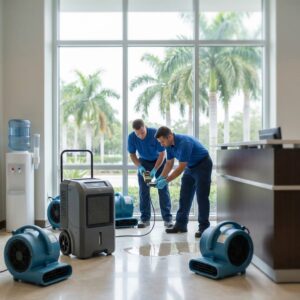
Our crews are fully equipped and authorized to begin emergency mitigation work immediately. This means water extraction, structural drying setup, and initial mold assessment happen while you’re still contacting your insurance adjuster. We don’t wait for approvals to start saving your property.
Action step: Add our emergency line to your home emergency kit alongside your fire extinguisher and first aid supplies. Include it on the contact list you share with family members and any roommates.
How We Achieve Faster Response Times Than Competitors
Speed requires systems. We’ve invested in three core areas that directly enable our quick response.
First, our dispatch technology uses GPS-enabled routing and real-time traffic data to send the nearest available crew to your location. We’re not assigning jobs based on which crew was last called. We’re assigning based on actual location and current availability. This eliminates the wasted time of crews driving across the county when someone’s already nearby.
Second, we maintain strategic equipment caches throughout Palm Beach County. Industrial-grade dehumidifiers, air movers, extraction units, and testing equipment are staged at multiple locations. When a crew arrives at your property, they’re not starting from our warehouse. They’re starting from a local depot. This saves 15 to 30 minutes on average, which can be the difference between containing water damage and allowing secondary damage to develop.
Third, we’ve streamlined our intake process. When you call, our dispatcher collects information about the water source, affected areas, and potential structural concerns. By the time our crew arrives, we already have a preliminary plan. We’re not walking in cold. We know whether we’re dealing with clean water from a burst pipe or contaminated water from a toilet overflow. We know if there are elderly occupants or pets that need special consideration. This preparation eliminates the assessment delay and gets crews to work immediately.
Our competitors often operate with centralized dispatch and single equipment warehouses, which adds 45 minutes to an hour to their response time in outlying areas.
Takeaway: When you call us, answer the dispatcher’s questions completely. We’re using that information to prepare, not to stall.
The Structural Risk of Delayed Water Damage Restoration
Structural damage accelerates in the hours after water intrusion. Drywall begins breaking down after about 48 hours of continuous moisture exposure. Wood framing can develop rot within days if not properly dried. Concrete subfloors trap moisture that creates ideal conditions for mold and mildew.
Here’s the progression we see repeatedly: Water enters on Saturday evening. Owner waits until Monday to call a restoration company. By Tuesday, the drywall is soft and beginning to separate from studs. By Wednesday, mold is visible on the bottom edges of baseboards. By Friday, the homeowner is facing not just water removal but full drywall replacement, wood treatment, and mold remediation.
Our rapid response interrupts this timeline. We extract standing water within hours. We deploy drying equipment within hours. We create airflow and reduce humidity before moisture has time to migrate deeper into structural materials. The difference is measurable in repair costs and in how much of the original structure we can preserve.
We’ve also seen cases where delayed response triggers additional damage. Wet insulation adds weight to ceiling structures. Water trapped in wall cavities can cause sagging. Compromised subflooring becomes a safety hazard. Quick response prevents these compounding problems.
Next step: If you notice water damage, don’t assume “we’ll deal with it tomorrow.” Call us immediately. The money you save on restoration costs will far exceed any inconvenience of a rapid dispatch.
Our Advanced Equipment and Dispatch Technology
We operate with commercial-grade equipment that’s simply more effective than standard equipment. Our dehumidifiers pull 200 to 300 pints of water from the air daily, compared to consumer-grade units that manage 50 to 70 pints. Our extraction equipment moves 300 to 500 gallons per minute, versus standard equipment at 100 gallons per minute.
This equipment matters because faster drying means less secondary damage and lower cost. A room that would take three weeks to dry with standard equipment might dry in five to seven days with our industrial setup. That’s two to three fewer weeks of mold risk, structural deterioration, and occupant displacement.
Our dispatch technology integrates with our scheduling system, equipment inventory, and crew assignments. When a call comes in, the system instantly knows which crew is closest, what equipment they’re carrying, and how long they’ll take to reach you. We can often have someone onsite before our competitors have even assigned a team. During peak periods like after a major storm, this system prevents the bottleneck that traditional companies experience.
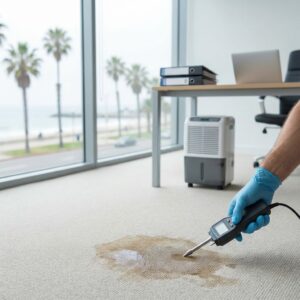
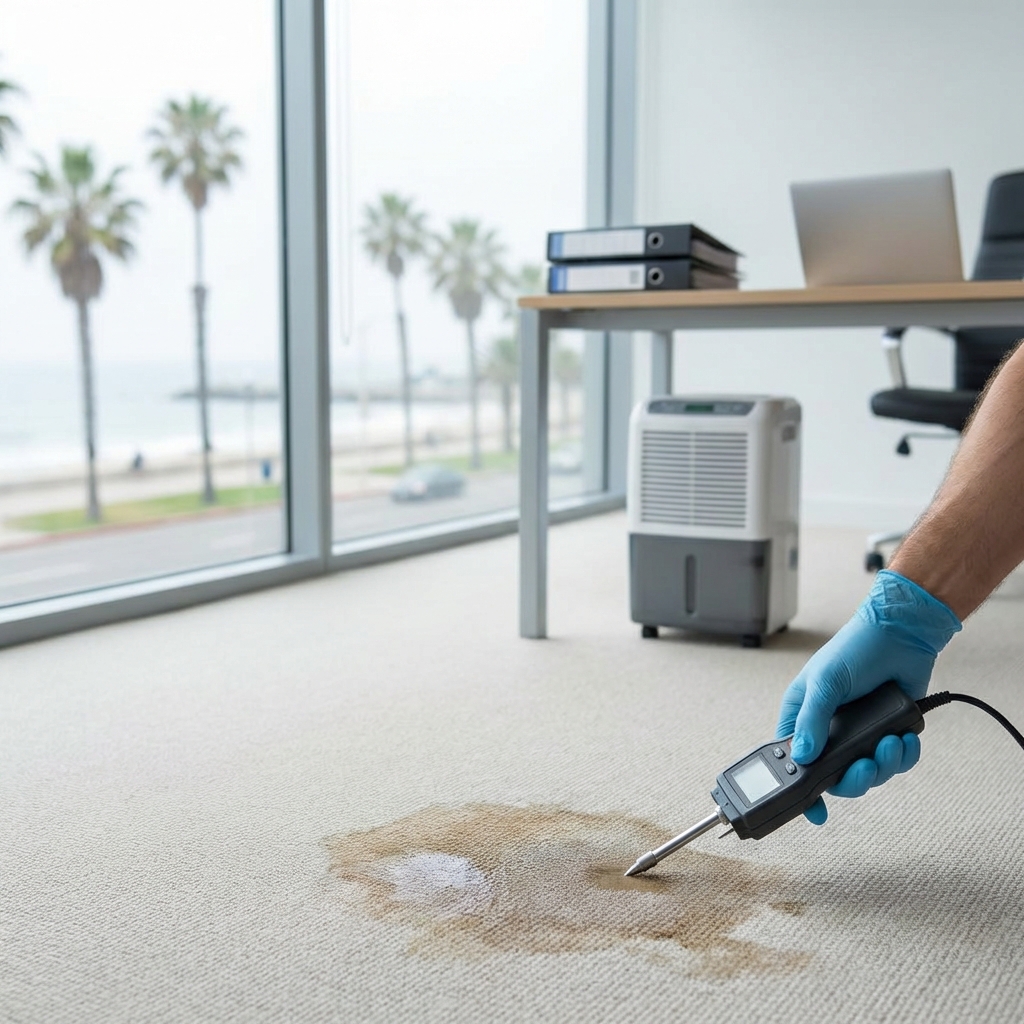
We also use moisture mapping technology that identifies water penetration in places you can’t see. Thermal imaging helps us find water trapped in wall cavities or behind baseboards. This prevents the scenario where we think we’ve handled the damage, only to discover mold growth weeks later in hidden areas.
What to implement: Before an emergency happens, know where your main water shutoff is located. You might be able to stop water from flowing while you’re waiting for us to arrive, which can meaningfully reduce total damage.
Why Palm Beach Homeowners Choose SuperClean for Speed and Quality
Speed without quality is just fast failure. We’re proud that our rapid response is matched by thorough, lasting restoration work. Speed comes first because it prevents additional damage, but quality comes immediately after because it ensures you’re not calling us again in six months when mold returns or the area hasn’t fully dried.

Our teams are certified through the Institute of Inspection Cleaning and Restoration Certification (IICRC), which means they’re trained in the latest mitigation and restoration techniques. We’re not hiring general contractors and teaching them on the job. We’re employing specialists who understand how water moves through structures, how mold develops and spreads, and how to properly restore properties to pre-loss condition.
Palm Beach homeowners choose us because they can get help fast without sacrificing standards. We answer quickly. We arrive quickly. We work thoroughly and document everything for insurance purposes. We don’t cut corners to stay on schedule.
We also understand the Palm Beach property market. Your home isn’t just a place to live. It’s a significant financial asset. We treat every restoration with that understanding, protecting the value of your property while we’re restoring it to livable condition.
Action to take: When comparing restoration companies, ask about certifications and training. Real expertise has credentials. Don’t settle for the fastest response if it’s coming from untrained technicians.
Insurance Claim Support That Moves Fast
Insurance documentation can move slowly. Adjusters have busy schedules. Estimates take time. We’ve learned to accelerate this process without pressuring anyone or cutting corners.
We document everything photographically as we work. We create detailed reports that show the water source, affected areas, mitigation steps taken, and restoration recommendations. This documentation is immediately available to your insurance company, which speeds up their assessment process. We’ve found that thorough documentation early in the process reduces claim disputes and speeds approval.
Our team members are experienced in talking with insurance adjusters. We can explain why certain mitigation steps were necessary, why certain materials need replacement, and how our approach aligns with industry standards. This communication helps your adjuster understand and approve the work faster.
We also handle the coordination between your insurance company, your contractor, and our restoration team. You don’t have to be the intermediary managing these relationships while you’re still dealing with the stress of water damage.
Practical guidance: Keep records of your initial emergency call with us. Note the time you called, the time our crew arrived, and what conditions we found. This timeline is valuable documentation for your insurance claim.
Mold Prevention Through Rapid Initial Response
Mold prevention isn’t a separate service. It’s a natural outcome of rapid water removal and proper drying. The key is that mold develops in moisture, and moisture develops when water sits and dries slowly.
Our rapid extraction removes standing water before mold spores have ideal conditions to germinate. Our industrial-grade dehumidifiers dry materials faster than mold can establish. Our air movers create air circulation that prevents the stagnant, humid conditions where mold thrives.
We also treat affected materials with antimicrobial solutions during the initial mitigation phase. This prevents mold from developing even if some moisture remains temporarily trapped in structural materials. We’re not waiting to see if mold appears. We’re preventing it from appearing in the first place.
In cases where mold has already begun to develop, rapid response still matters. Early intervention catches mold while it’s still localized and easier to remediate. Waiting allows mold to spread through HVAC ducts, across wall cavities, and into materials that would otherwise be salvageable.
Key takeaway: Don’t assume water damage that looks clean is mold-free. Call us for assessment. Mold can be developing in places you can’t see, and rapid professional intervention catches it before it becomes a health concern.

Our Track Record in Hurricane-Affected Areas
Palm Beach has weathered major hurricanes in recent years, and we’ve been the response team for hundreds of properties during and after these events. We’ve learned what works when entire neighborhoods are affected simultaneously and standard restoration timelines become impossible.
During hurricane recovery, we prioritize properties based on severity and occupancy. A family with elderly residents or young children moves higher in the queue than a vacant commercial space. We maintain communication with local authorities about which areas have been cleared for restoration work. We coordinate with debris removal crews. We work extended hours when the entire community needs restoration simultaneously.
Our experience means we know how to handle the specific challenges of hurricane damage: saltwater intrusion, widespread structural damage, contaminated water, and the combination of wind and water damage. We’ve documented what materials can be salvaged, what needs replacement, and how to properly address the unique restoration challenges that hurricanes create.
We also have relationships with insurance companies that expedite hurricane claims. We understand the surge in documentation and approvals that happens after major storms, and we’ve developed processes that keep your claim moving even when adjusters are overwhelmed.
Relevant insight: If you’re in a hurricane-prone area, consider discussing a restoration plan with us before hurricane season. Knowing who to call and what to expect reduces panic and accelerates response when a storm hits.
What Sets Our Emergency Protocol Apart
Our protocol is designed around the principle that the first hours are the most critical. Here’s what happens when you call us:
Dispatcher takes your information and creates an emergency ticket with priority status based on water source and affected area. GPS dispatch sends the nearest available crew with real-time routing. Crew notifies you of ETA while gathering initial information from the dispatcher. Upon arrival, crew secures the property, identifies the water source, and begins assessment while you provide access. Mitigation begins immediately: water extraction, initial drying setup, and damage documentation. Crew provides you with a preliminary report and begins coordinating with your insurance company.
This isn’t a generic protocol. It’s specifically designed to get professional mitigation started before secondary damage develops. We’re not following a checklist that delays action. We’re executing a plan that moves forward simultaneously rather than sequentially.
We also maintain flexibility within the protocol. A water intrusion in an attic requires different immediate action than water in a basement. A commercial property with server rooms needs different prioritization than a residential home. Our crews are trained to adapt the protocol based on the specific situation while maintaining the core principle of rapid mitigation.
Implementation tip: When our crew arrives, answer their questions about the water source completely. Knowing whether water came from a burst pipe, roof leak, or flooding helps us prioritize immediate actions correctly.
Getting Help Now: Your Next Steps with SuperClean
When water damage happens, your response in the first minutes determines your outcomes. We’re available 24/7 to provide immediate assessment, emergency mitigation, and restoration coordination.
Call us now if you’re currently dealing with water damage. Save our number for when you need it. If you’re in the preparation phase, consider scheduling a property walk-through to identify potential water intrusion points and develop a response plan.
We service residential and commercial properties throughout Palm Beach County with the same commitment to rapid response and quality restoration. Whether you’re facing an active emergency or want to be prepared, we’re ready to help.
Our Palm Beach water damage experts are standing by to provide the fastest professional response in the county.