Why Water Damage Claims Fail for Palm Beach Landlords
Managing rental properties in Palm Beach comes with unique challenges. The combination of tropical weather, aging infrastructure, and seasonal storms creates an environment where water damage isn’t a matter of if, but when. We’ve worked with hundreds of landlords who faced water damage claims, and we’ve noticed a clear pattern: those who handle the process strategically recover faster and receive higher claim payouts. Those who don’t often see denials, delays, and depleted insurance limits that could have been avoided.
This guide walks you through the critical steps we recommend to maximize your water damage claims and protect your investment.
The most common claim denials we encounter stem from preventable oversights. When a landlord waits too long before calling for help, insurance adjusters view it as negligence. When documentation is incomplete or poorly organized, adjusters have legitimate grounds to deny portions of the claim. When the restoration process happens haphazardly without proper evidence collection, entire categories of damage get dismissed.
We’ve seen landlords lose thousands because they didn’t photograph damage before cleanup, didn’t preserve wet materials for inspection, or didn’t maintain a timeline of events. Insurance companies are looking for reasons to limit payouts, and incomplete claims give them ammunition.
Another frequent failure point is misunderstanding your policy limits and coverage exclusions. Many landlords assume all water damage is covered equally. In reality, claims stemming from poor maintenance, lack of inspection, or “gradual seepage” are often denied outright. Coverage also varies significantly between sudden-impact damage (a burst pipe) versus sustained water intrusion (a roof leak that went unnoticed for months).
Coordination failures also sink claims. When landlords hire restoration contractors before the adjuster inspects the property, it muddies the claim. When they don’t communicate with us about what the insurance company expects, misaligned work orders create disputes about what’s covered.
What to do next: Before any water enters your property, review your landlord insurance policy. Understand what’s covered, your deductible, your coverage limits, and any maintenance requirements. Write down questions and call your agent.
The Hidden Costs of Delayed Response to Water Damage
Time is your enemy when water damage strikes. Every hour of delay means more water absorption into walls, flooring, and structural components. Secondary damage compounds quickly: hidden moisture leads to mold growth within 24-48 hours, structural wood begins to weaken in days, and electrical systems corrode.
When you wait, your claim’s value actually increases on the surface but decreases in practical recovery. More damage means a larger claim, but also more opportunity for the adjuster to question whether proper preventive maintenance was in place. If we arrive days later and find mold already established, the adjuster may argue that faster response could have prevented it, reducing your payout.
Beyond insurance considerations, delayed response costs you tenants. A water-damaged unit sitting unrepaired drives them out, leaving you with lost rent and the challenge of re-leasing a property with unresolved moisture issues. Properties showing moisture damage rent for less and attract fewer qualified tenants.
The structural integrity risk is real. Water-saturated wood loses strength. Drywall absorbs water like a sponge and becomes structurally compromised. Steel framing begins rusting. These aren’t cosmetic issues. They’re safety hazards that escalate repair costs and expose you to liability. A tenant injured due to water-damaged structural elements creates legal exposure beyond the property damage itself.
We’ve documented cases where a 12-hour delay in calling for emergency response cost landlords 30-40% more in total remediation expenses. The immediate extraction and structural drying we provide in the first hours prevent cascade damage that multiplies costs.
What to do next: Program our 24/7 emergency line into your phone now: (561) 555-0123. Have a contact person available who can authorize immediate response for your properties.
How We Document Water Damage for Insurance Success
Our documentation process is built specifically for claim approval. When we arrive, we begin a systematic record that becomes your insurance evidence file.
First, we capture the scene as we find it. High-resolution photographs document the water source, affected areas, water depth where measurable, and staining patterns. We photograph from multiple angles and distances to show both the scope and specific details. These images form the backbone of your claim.
Next, we create a detailed timeline. We record the exact time we receive your call, the time we arrive, ambient conditions, and our initial assessment. We note whether the water is still active, the apparent source (burst pipe, roof leak, plumbing failure, exterior intrusion), and which materials are affected. This timeline becomes critical when adjusters question when damage occurred.
We measure and document affected square footage room by room. We record material types (drywall, flooring, cabinetry, insulation, framing). We photograph moisture meter readings from affected materials to establish baseline humidity levels that support the claim. These readings prove that moisture penetration occurred and justify the need for structural drying.
Our moisture mapping shows exactly which areas need remediation and to what depth. This prevents the adjuster from claiming you’re over-claiming damage in unaffected zones. It also prevents underclaiming by ensuring every affected area gets documented.
We create a written scope of work that details every step needed to restore the property. This becomes your restoration contract and serves as the blueprint your insurance adjuster references when approving work. Clear scope prevents disputes later about what’s covered.
Our documentation includes before-and-after comparisons that show the exact transformation of each space. When the adjuster sees a soaked bedroom transformed back to livable condition, the claim value becomes concrete rather than theoretical.

What to do next: Request our documentation package when you call for emergency response. Let us know your insurance company so we can format records specifically for their claims process.
Our 24/7 Emergency Response Advantage
We operate around the clock because water damage doesn’t follow business hours. A pipe burst at 2 AM on a Saturday needs immediate attention, not a callback Monday morning.
Our 24/7 availability means we’re typically on-site within 60-90 minutes of your call in Palm Beach County. This rapid response is what prevents secondary damage from consuming your claim. We begin water extraction immediately, deploy structural drying equipment that night, and prevent the mold growth that would compound your insurance nightmare.
When you call us at 2 AM with a flooded commercial property, we send a fully equipped crew with truck-mounted extractors, industrial dehumidifiers, and moisture detection equipment. We’re not just showing up; we’re immediately mitigating. Every hour we save on response time translates to less damage, lower remediation costs, and fewer claim complications.
Our emergency protocols ensure that initial response doesn’t compromise your claim. We document everything before moving anything. We take photos before extraction. We photograph the water source before we seal it. We’re not just fixing the property; we’re building your claim evidence simultaneously.
After-hours response also matters for tenant communication. When a tenant experiences water damage at night, having a restoration crew arrive within hours reassures them and prevents panic decisions. Landlords who respond quickly retain tenants; those who delay lose them and face vacancy costs that dwarf the restoration expense.
Our emergency line connects you with a dispatcher who can authorize immediate dispatch without waiting for callbacks. We arrive with the right equipment from the start, not undersized tools that require multiple trips and wasted time.
What to do next: Save our emergency number (561) 555-0123 in your phone as a contact, not just a reference. Include it in your property management system and tenant communication materials.
Mold Testing and Remediation We Provide
Mold grows invisibly in wet environments. By the time you see it, the problem is already established in walls, under flooring, and in HVAC systems. Our testing protocol identifies mold before it becomes a tenant health issue or a claim dispute.
We conduct air quality testing that measures mold spore concentration in affected areas and unaffected baseline areas. This comparison proves that mold elevated due to the water damage event, not pre-existing conditions. Insurance companies look for this evidence before authorizing remediation costs.
Surface testing identifies specific mold species and concentration levels on materials. This data determines whether materials can be cleaned and restored or must be removed and replaced. It also establishes the remediation protocol we use, which our documentation proves was appropriate for the contamination level found.
Our remediation approach varies by contamination extent. For limited surface mold, we apply EPA-approved antimicrobial treatments and monitor for recurrence. For pervasive contamination, we isolate the work area with negative pressure containment to prevent spore spread to unaffected zones. We remove affected materials per protocol and replace them with new, treated materials.
The critical piece for your claim is that our mold work is justified by testing data. We’re not guessing about extent or remediation method. We’re backing every dollar spent with documentation that insurance adjusters can defend to their supervisors.
Post-remediation testing verifies that mold levels returned to normal baseline levels. This completion certificate protects your property and proves to future buyers or lenders that the issue was completely resolved. It also protects your claim by showing that remediation was thorough and successful.
What to do next: Request mold testing as part of your water damage claim, even if you don’t yet see visible mold. Testing now prevents disputes later about whether hidden mold growth was part of the original damage event.
Coordinating with Your Insurance Adjuster
The relationship between restoration work and insurance approval often determines claim success. We’ve developed a coordination approach that keeps your adjuster informed while protecting your interests.
Our first step is getting your claim number and adjuster contact information from you. We don’t proceed with full-scope restoration without either adjuster approval or your authorization to begin emergency mitigation while the claim is being processed.
We prepare a detailed estimate that matches your insurance company’s format preferences. Different insurers use different estimate structures. We’ve worked with every major carrier in Florida, so we know what information each company requires to approve coverage. We structure our estimates so adjusters see clearly what they’re evaluating.
We schedule the adjuster’s inspection at a time when we can be present to explain our findings. When the adjuster sees our moisture readings, our documentation, and our explanation of what caused the damage and why specific remediation is necessary, they understand the claim better. Questions get answered in real-time rather than in frustrating back-and-forth phone calls.
For contentious situations where an adjuster seems skeptical, we provide independent third-party verification. We can arrange for an engineer to assess structural concerns or a certified mold inspector to validate our testing. These independent voices carry weight that our own assessments sometimes lack.
If an adjuster denies coverage for a portion of your claim, we provide detailed written explanation of why that specific damage resulted from the insured event and why it needs remediation. We cite building codes, insurance industry standards, and technical documentation. We’re not arguing; we’re educating the adjuster about why their initial denial wasn’t technically sound.

We also coordinate timing so that adjuster approval comes through before we complete irreversible work. If the adjuster needs additional photos or information, we provide it quickly. Delays in claim approval create scheduling challenges, but we work around them rather than proceeding without coverage confirmation.
What to do next: Provide us your claim number, adjuster name, and carrier contact within 24 hours of calling for emergency response. This enables immediate coordination rather than starting that process days later when claims review begins.
Structural Drying and Disinfection Services
Water damage isn’t solved by removing standing water. Moisture trapped in structural materials continues causing damage long after visible water is gone. Our structural drying process eliminates hidden moisture that causes the real cost.
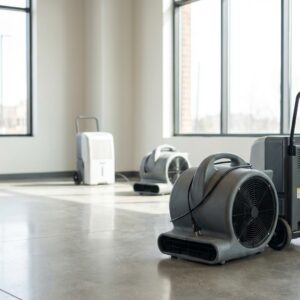
We deploy industrial-grade dehumidifiers that remove moisture from the air, forcing it out of saturated materials. A single commercial-grade dehumidifier removes 100+ gallons of water daily from the air in an affected space. For significant damage, we deploy multiple units working in coordination.
We use structural air movers that create targeted airflow through walls, under flooring, and above ceilings. These aren’t household fans. They’re engineered systems that move massive volumes of air, creating evaporative drying that penetrates materials ordinary drying can’t reach.
Moisture monitoring during drying is where many restoration companies fall short. We test material moisture levels daily using calibrated meters. We track how quickly moisture is decreasing and adjust equipment placement if certain areas are drying slower than expected. This data-driven approach prevents premature equipment removal that leaves moisture behind.
The disinfection phase kills pathogens and odor-causing bacteria that water damage introduces. We apply EPA-approved antimicrobial treatments to affected materials, focusing on areas where biological growth is likely. We use foggers and electrostatic technology to ensure complete coverage, not just surface treatment.
We also address HVAC system moisture. Water that enters ductwork and HVAC components creates ongoing odor and mold risk. We clean and treat these systems so they’re not continuously spreading contamination throughout the building even after visible water damage is resolved.
Most critically, our drying process is documented with daily moisture readings and equipment placement photos. This documentation proves to your insurance company that we used appropriate industrial-grade remediation rather than simply airing out the space with box fans.
What to do next: Ask us for daily drying progress reports during the structural drying phase. These reports become part of your claim file and demonstrate that we’re following industry-standard protocols.
Understanding Your Coverage and Our Role
Insurance policies contain language about what restoration expenses fall under coverage versus what constitutes maintenance that’s your responsibility. Understanding this distinction prevents claim disputes.
Water damage from sudden, accidental causes is typically covered. A burst pipe, a roof leak from a storm, or backed-up plumbing from a clog usually triggers coverage. However, many policies exclude damage resulting from lack of maintenance. A roof leak that developed because you ignored deteriorated shingles for years falls into this category.
Our documentation helps clarify this distinction. We photograph the condition of plumbing, roofing, and mechanical systems. If damage resulted from poor maintenance, we identify that. If damage resulted from a sudden event despite reasonable maintenance, we document that too. Insurance companies want to know the difference, and our evidence helps them make that determination accurately.
Coverage limits matter significantly. Many landlords have per-occurrence limits that cap what a single claim pays. If you have a $25,000 limit but $35,000 in damage, the difference comes out of your pocket. We help you understand your specific limits so you’re not surprised later.
Deductibles also factor into claim economics. A $2,500 deductible means you pay that amount regardless of total damage. Our work focuses on scope and prioritization, ensuring that the work we do first is work that falls within your coverage so you’re not spending deductible money on ineligible expenses.
Our role is strictly professional restoration. We’re not responsible for policy interpretation or claim approval decisions. However, we provide clear documentation that enables your insurance company to make informed decisions. We also explain what we’re finding so you understand what’s covered and what isn’t.
If damage extends beyond insurance coverage, we discuss options for addressing it. Sometimes limiting scope to covered items makes financial sense. Sometimes covering uncovered items from your own resources prevents larger problems. We present options; you make the decision.
What to do next: Contact your insurance agent and request written clarification of your coverage limits, deductibles, and exclusions. Bring that documentation to our initial assessment so we understand your financial constraints from the beginning.
Steps to File a Successful Claim
The filing process itself significantly impacts claim outcomes. Following a structured approach prevents oversights that lead to denials or delays.
Step one is notifying your insurance company immediately. Don’t wait for our assessment. Contact your carrier and report the water damage the same day it occurs. Document the time you called, who you spoke with, and what information you provided. This establishes that you reported promptly, which some policies require.
Step two is calling us for emergency response. The sooner we arrive, the sooner we begin documentation and mitigation. Your claim’s success depends partly on how quickly secondary damage was prevented.

Step three is gathering documentation materials. Collect receipts for any emergency spending (emergency contractors, temporary housing for displaced tenants, emergency supplies). Compile photos you took before we arrived. Locate your insurance policy and claim-related correspondence.
Step four is coordinating your adjuster appointment. Provide us with the adjuster’s contact information, and we’ll schedule the inspection at a time we can attend. If we’re not present, important technical details go unexplained.
Step five is reviewing our documentation package. We provide a complete file containing photos, moisture readings, timeline, scope of work, and estimates. Review these materials, ask questions, and ensure they accurately represent what occurred.
Step six is submitting our documentation to your insurance company. Provide them with our photos, estimates, and technical reports. These professional documents carry more weight than casual documentation or explanations.
Step seven is following up on claim status. Insurance companies are slower than we’d like. Check with your adjuster weekly about approval status. If approval delays, ask what additional information is needed.
Step eight is proceeding with restoration once coverage is approved. We schedule the work, execute it systematically, and provide completion documentation.
What to do next: Create a file folder for water damage claim materials right now (digital or physical). When damage occurs, every communication, photo, and document goes into that folder immediately. This prevents losing critical information during the stress of the event.
Why Professional Restoration Protects Your Property Value
A water-damaged property that’s restored hastily or partially suffers long-term value loss. Buyers and lenders recognize evidence of incomplete restoration and adjust prices accordingly. Our professional approach preserves value.
Professional-grade documentation of complete restoration provides confidence to future buyers. When a property has a history of water damage but clear evidence of professional remediation, that story is far less damaging than a property with evidence of incomplete repair.
Our structural drying ensures that hidden moisture doesn’t continue causing problems long after visible restoration is complete. Properties with lingering moisture issues develop mold, odor, and structural weakness that significantly reduce value. Complete drying prevents these problems.
Our documentation of mold remediation is crucial. Future buyers and their inspectors will look for mold. When you have clear documentation that any mold was identified, professionally remediated, and tested to confirm resolution, the property’s mold risk profile is clear and manageable. Properties without this documentation carry massive uncertainty, which buyers price heavily downward.
Professional disinfection and odor removal restore the property to pre-damage condition rather than leaving subtle indicators of the water event. Many restoration companies skimp on this phase because it’s less visible. We complete it thoroughly because it affects both value and occupant experience.
Professional-grade materials and workmanship used during restoration ensure durability. Using off-brand flooring or drywall to save costs creates quality issues that resurface years later, damaging your property’s reputation and value.
Beyond the restoration itself, our participation in the insurance claim ensures that the damage repair is on record with documentation that protects future disclosures. You can show buyers that damage was professionally assessed, properly repaired, and successfully resolved.
What to do next: If you own multiple properties, prioritize completing comprehensive restoration on each one. Incomplete restoration that lingers for months or years creates compounding value loss far exceeding the restoration cost.
Our Track Record with Palm Beach Landlords
We’ve worked with Palm Beach landlords managing everything from single-family rentals to large apartment complexes. The pattern is consistent: landlords who call us early and follow our guidance recover fully and quickly. Those who delay or attempt DIY restoration face extended timelines and incomplete recovery.
A Wellington landlord called us after discovering water in a rental property basement. We arrived within an hour, identified a sump pump failure as the cause, and began extraction and structural drying that afternoon. Our documentation clearly established sudden failure as the cause. The insurance company approved full coverage within five business days. The landlord had the property dried and ready for re-lease within two weeks. Total claim resolution: three weeks from discovery to completion.
A commercial property owner in West Palm Beach experienced a roof leak during a summer storm. The leak went undetected for nearly 48 hours because the property was unoccupied. By the time it was discovered, significant mold growth had developed in the attic space. We were called for remediation, but mold had already spread extensively. The insurance company approved the claim, but the extended timeline and scope far exceeded what early detection would have required. The lesson: routine inspections catch problems earlier and prevent escalation.
A multi-unit residential property experienced a plumbing failure affecting three units. The landlord attempted initial water removal using a wet-vac before calling us. By the time we arrived, water had spread beyond the initial affected area, and contamination risk had increased. The insurance claim took longer because questions arose about whether the initial DIY response had caused additional spread. Professional first response would have prevented this complication.
These cases represent hundreds of similar engagements where our systematic approach saved landlords thousands in restoration costs, eliminated claim complications, and maintained property value.
What to do next: Save this guide and share it with your property manager or maintenance team. When water damage occurs, the people closest to your properties need to know that our 24/7 emergency water restoration services are the right first call, not a last resort.
When water damage threatens your Palm Beach rental property, the decisions you make in the first hours determine your claim outcome and your property’s recovery. We’re available around the clock to help you navigate that process successfully. Call us immediately at (561) 555-0123 when damage occurs. We’ll be there within 90 minutes with the expertise and documentation approach that turns a potential disaster into a managed recovery.