Understanding Your Commercial Water Damage Crisis
When water enters your commercial property, every hour matters. A burst pipe, flooding from storms, or failed HVAC systems can compromise your entire operation within days. Unlike residential damage, commercial water damage threatens your business continuity, employee safety, inventory, equipment, and revenue.
We’ve responded to countless emergencies across Palm Beach County and know that business owners face immediate pressures: reopening timelines, insurance requirements, tenant relationships, and regulatory compliance. A 2,000-square-foot office building with water pooling on two floors isn’t just a cleanup job; it’s a race against structural deterioration, mold colonization, and equipment failure.
The real cost extends beyond visible water damage. Unsealed moisture trapped in walls and under flooring becomes a breeding ground for mold within 24-48 hours. Affected HVAC systems can spread contamination throughout your entire building. Hardwood floors, drywall, and electrical systems suffer hidden damage that compounds over time.
Your first decision determines everything that follows: choosing a restoration partner who understands commercial-scale restoration, not just residential cleanup. We’ve built our practice around commercial property owners who need rapid response paired with forensic-level assessment and documentation that satisfies insurance adjusters.
What We Look For in Restoration Partners
We evaluate restoration companies through the lens of what actually protects your business. The right partner combines immediate availability, technical expertise, and communication transparency.
Start by verifying certifications and credentials. We hold IICRC (Institute of Inspection, Cleaning and Restoration Certification) certifications across water damage, mold remediation, and applied structural drying. These aren’t just credentials; they represent tested methodologies and continuing education in evolving restoration techniques.
Equipment capability matters significantly. Commercial water damage requires industrial-grade extraction units, commercial dehumidifiers rated for large spaces, and moisture detection technology that maps hidden water behind walls and under concrete. A company equipped only for residential jobs will underestimate your extraction and drying needs.
Insurance familiarity is non-negotiable. Your restoration partner should speak fluent insurance language: proper documentation, moisture readings that support claims, photos and reports that adjusters expect, and clear timelines that prevent disputes. We maintain relationships with major carriers in Florida and understand their specific documentation requirements.
Response time directly impacts your final costs. The first 24-48 hours determine whether this becomes a $15,000 water extraction or a $150,000 structural reconstruction. Companies claiming “24-hour response” don’t meet commercial emergency standards. We deploy crews within two hours of your call, seven days a week.
Ask about their post-drying protocols. Water removal is just the first step. Dehumidification, air circulation, and mold prevention require days of specialized management. Insufficient drying leads to delayed mold growth that emerges weeks after the water appears gone, creating secondary liability and additional remediation costs.
Speed and Emergency Response Capabilities
Commercial properties don’t close at 5 p.m. Your emergency happens at 11 p.m. on Thursday, and you need boots on the ground before Friday’s opening.
We staff 24/7 emergency dispatch with technicians on rotation across Palm Beach County. When you call, you reach a real person, not an automated service. Our dispatcher assesses your situation, confirms crew availability, and typically has our team en route within 90 minutes. For properties flooded from hurricane-related events or pipe failures requiring immediate water removal, we mobilize multiple crews simultaneously.
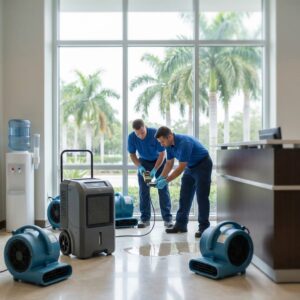
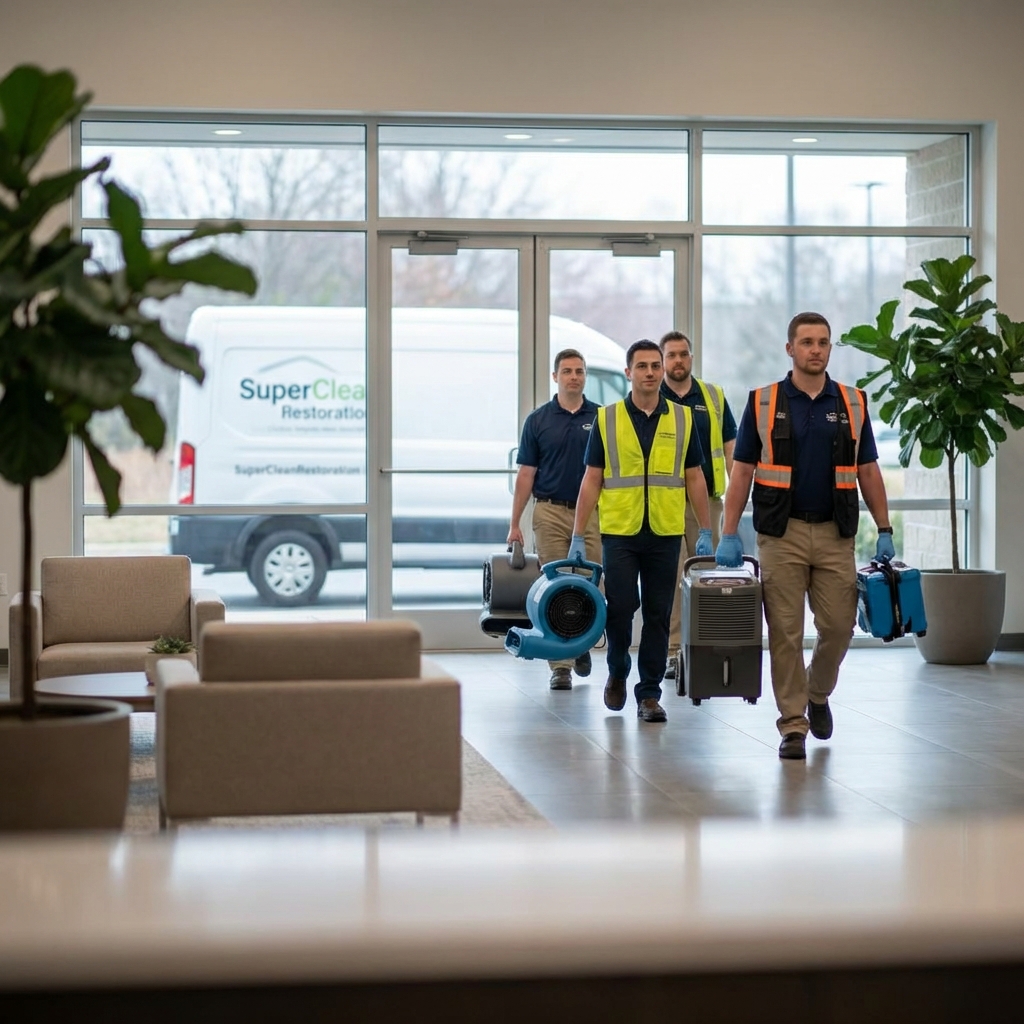
Our equipment staging and rapid deployment strategy means we arrive ready to work. We don’t order equipment from suppliers; our vans carry commercial-grade pumps, extraction units, dehumidifiers, and moisture mapping technology. Crew members are trained to begin water extraction within minutes of arrival.
The first four hours establish your trajectory. Our initial actions include:
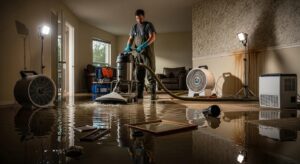
- Rapid water removal using industrial submersible pumps and truck-mounted extractors
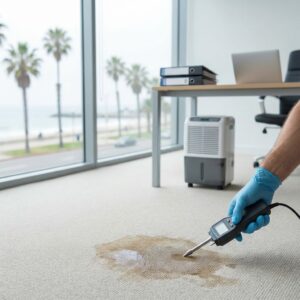
- Moisture detection mapping to identify water migration behind walls and under flooring
- Critical structural assessment to determine structural integrity and safety concerns
- Electrical systems evaluation to prevent hazards and guide utility shutoff decisions
- Documentation and photography for insurance purposes
Commercial properties present unique challenges: large open floor plans requiring coordinated dehumidification, multiple tenant spaces with water containment needs, and complex HVAC systems that risk spreading contamination. We’ve restored medical offices, manufacturing facilities, retail spaces, and multi-tenant buildings. That experience translates to faster assessment and more accurate restoration planning.
Expertise in Commercial Property Assessment
The assessment determines your restoration scope and final cost. We conduct detailed, forensic-level evaluations that go beyond “the water is here.”
Our process maps affected materials and material composition. Porous materials like gypsum drywall, wood framing, and insulation absorb water differently than sealed concrete, tile, or metal. The standard 72-hour drying timeline assumes porous materials in temperate conditions. Commercial spaces with sealed concrete, extensive mechanical systems, or environmental controls often require modified protocols.
We test for contaminated water versus clean water. A broken supply line produces different restoration requirements than flooding from stormwater or sewage backup. We classify damage using IICRC standards and document the classification in our assessment report, which becomes critical for insurance processing.
Structural assessment identifies safety hazards immediately. Compromised floor substrates, water-damaged electrical panels, or failed roof connections require emergency stabilization. We coordinate with structural engineers when necessary and provide clear communication about whether spaces are safe for occupancy during restoration.
For commercial properties, we evaluate business continuity impact. How quickly can you restore the affected areas? Which spaces can reopen first? Can operations shift to other locations while core areas dry? Our assessment includes a realistic drying timeline with specific milestones, so you can communicate reopening dates to employees, tenants, and customers.
We document building systems thoroughly. HVAC systems, electrical infrastructure, data systems, and mechanical equipment all require assessment for water exposure and contamination risk. We work with your facilities team and building engineers to coordinate system shutdowns, cleaning, and restoration sequencing.
Insurance Claim Navigation Support
Filing an insurance claim for commercial water damage involves multiple stakeholders: your carrier’s adjuster, your business interruption coverage, property coverage, and potentially landlord/tenant provisions. The documentation we provide either streamlines this process or creates friction.
We generate detailed scope-of-work reports that insurance adjusters expect. These documents include:
- Photographs of affected areas with moisture readings
- Affected square footage by material type
- Classification of water source and damage category
- Drying methodology and timeline
- Itemized restoration costs with labor and equipment specifications
- Moisture monitoring results confirming successful drying
Our team communicates directly with adjusters when you authorize it. We explain our assessment findings, drying protocols, and restoration decisions in language adjusters understand. This collaboration prevents disputes about methodology and cost reasonableness.
Business interruption claims require different documentation. Adjusters need specific timelines showing when spaces became unusable and when we restored them to occupancy. Our detailed progress reports and final drying verification create the paper trail that supports your business interruption claims.
We also flag coverage issues early. If your building sits below ground level and sustained flooding from external sources, your claim may involve separate coverage provisions than internal pipe failures. If water damaged inventory or equipment, those may require separate claim filing. Identifying these distinctions upfront prevents claim denials after our restoration concludes.
Advanced Drying and Structural Restoration
Water extraction alone doesn’t restore a commercial property. The drying phase determines whether you avoid secondary damage like mold, structural degradation, and material delamination.
Our drying methodology uses strategically placed commercial dehumidifiers sized for your space volume. A 10,000-square-foot office building requires different dehumidification capacity than a 2,000-square-foot suite. We calculate dehumidifier requirements based on cubic footage, material saturation levels, and environmental conditions. Undersizing dehumidification is the primary cause of failed drying that leads to delayed mold growth.
Air circulation moves moisture from wet materials toward dehumidifiers. We deploy industrial axial fans and carpet dryers to create airflow patterns that prevent moisture pockets. Closed-off spaces like interior walls, mechanical closets, and below-structure areas receive targeted dehumidification equipment to prevent hidden moisture retention.
Monitoring equipment runs continuously during drying. Moisture meters record readings in drywall, subflooring, and concrete. We establish baseline readings immediately after extraction, then monitor progress daily. Successful drying shows consistent moisture decline toward acceptable levels. If readings plateau or increase, we adjust our equipment and methodology.
Structural restoration addresses materials damaged beyond drying recovery. Saturated drywall often requires replacement; attempting to dry drywall with high moisture content invites internal mold growth. Affected insulation typically needs removal and replacement. We coordinate these structural repairs with our drying efforts to prevent recontamination.
Hardwood flooring and concrete present different challenges. Hardwood may require sanding and refinishing if buckled by water exposure. Concrete sometimes needs dehumidification from below and surface sealing to prevent moisture migration. We assess each material type individually and recommend appropriate restoration methods.
Mold Prevention and Remediation Standards
Preventing mold is infinitely easier and cheaper than remediating it after colonization. Our restoration process prioritizes mold prevention from the moment water is extracted.
We apply antimicrobial treatments to affected surfaces during the drying phase. These treatments don’t replace proper drying; they’re a secondary measure that reduces mold spore viability on partially wet materials. Applied correctly, antimicrobial treatment combined with accelerated drying prevents the mold colonization that typically begins at 48 hours post-water damage.
If mold growth has already occurred, we follow IICRC mold remediation standards. Small areas (less than 10 square feet) we remediate in place with containment and HEPA-filtered removal. Larger areas require isolation, negative pressure containment, and professional removal of contaminated materials.
Our mold assessment identifies affected materials that aren’t visually obvious. Mold grows inside walls, under flooring, and within HVAC ductwork. We use moisture mapping and air quality testing to identify problem areas before they become visible. This proactive approach prevents secondary mold issues that emerge weeks after visible water damage appears resolved.
Post-remediation verification ensures mold removal succeeded. We test air samples and surface samples to confirm mold spore levels return to normal background levels. Final clearance only occurs after testing validates successful remediation. This verification protects you against liability claims from employees or occupants later claiming mold exposure.
Why SuperClean Restoration Stands Apart
We’ve built our business around one principle: commercial water damage demands a partner who understands business continuity, not just water cleanup.
Our team includes technicians with 10-20 years of commercial restoration experience. This isn’t their first major flood; they’ve restored multi-story office buildings, manufacturing facilities, retail centers, and medical offices. That experience translates to faster assessment, more accurate timelines, and anticipation of complications before they derail your recovery.
We maintain equipment inventory sized for large commercial projects. We don’t rent dehumidifiers and extractors when your building floods; we deploy our own equipment within hours. This equipment readiness combined with our local dispatch capability means we start work while competitors are still arranging equipment delivery.
Our insurance relationships streamline claims processing. We’ve worked with adjusters from major carriers for years and understand their documentation requirements, inspection preferences, and timeline expectations. This familiarity accelerates claim approval and prevents disputes about our restoration methodology.
We integrate structural and HVAC expertise. Water damage typically requires coordination between water remediation, structural assessment, and mechanical system restoration. We manage this coordination internally rather than referring you to multiple contractors. This integration reduces project timelines and prevents gaps where moisture migrates into systems during handoffs between contractors.
Our water and mold experts hold current certifications across water damage, mold remediation, and structural drying. Certifications matter because they represent tested methodologies, ongoing education, and professional standards that guide our decision-making.
Our Proven Track Record in Palm Beach
Our work across Palm Beach County has built a foundation of successful commercial restorations that speak directly to our capabilities.
We’ve restored major office buildings in West Palm Beach following pipe failures and storm flooding. One 50,000-square-foot commercial complex experienced water damage affecting 75 percent of the building. We coordinated extraction, structural assessment, and drying across multiple tenant spaces while maintaining partial building operations. The property reopened at full capacity within 18 days.
We’ve handled manufacturing facilities where water damage threatened equipment and inventory. A warehouse flooded during a hurricane-related storm surge. We coordinated rapid water removal, structural stabilization, and equipment preservation that allowed the facility to resume production within two weeks.
Medical offices present unique complications: sterile environments, specialized equipment, and regulatory compliance requirements. We’ve restored several medical facilities where water damage required not only structural remediation but also compliance verification with healthcare facility standards. Our understanding of these unique requirements prevented shutdown extensions that would have disrupted patient care.
Retail properties depend on rapid reopening to minimize revenue loss. We’ve restored several retail centers where we coordinated water extraction across multiple tenant spaces while managing the logistics of partial reopening. Successful restorations here required balancing individual tenant needs with shared building systems restoration.
Our experience with hurricane-related damage reflects Palm Beach County’s storm exposure. We’ve responded to multiple major hurricanes and tropical storms, managing surge flooding, wind-driven water intrusion, and secondary water damage from compromised roofs and structural failures. That experience taught us how to prioritize emergency stabilization while planning long-term restoration.
How to Get Immediate Help Today
When water enters your commercial property, contact us immediately. We operate 24/7 and can have a team dispatched to your property within two hours.
Call our emergency line at your earliest opportunity. Our dispatcher will gather essential information: your property location, water source, affected areas, and building occupancy status. This information helps us stage the right equipment and personnel for your specific emergency.
Your call triggers our rapid-response protocol. We dispatch our nearest available crew and begin equipment mobilization. While your crew travels, we’re loading extraction units, dehumidifiers, and assessment equipment. This parallel preparation means work begins within minutes of our arrival.
Prepare for our arrival by securing valuables, turning off electrical systems in affected areas, and ensuring safe access to water sources and affected spaces. Document the damage with photos if it’s safe to do so; this documentation supports your insurance claim.
Once our team arrives, we begin with rapid water extraction followed by immediate assessment. We’ll explain our findings, answer questions about your property’s damage, and outline our recommended restoration plan with realistic timelines.
We partner directly with your business through the entire recovery process. You’ll receive daily updates on drying progress, milestone completion, and anticipated reopening dates. Our approach prioritizes transparent communication because your business can’t plan recovery without clear information about what to expect.
SuperClean Restoration Palm Beach brings commercial-scale expertise, 24/7 emergency response, and proven experience across Palm Beach County. When water damage threatens your business, you need a partner who understands commercial restoration and can act immediately. We’re here to restore your property and your business continuity with professional expertise and transparent communication from emergency response through final drying verification.